
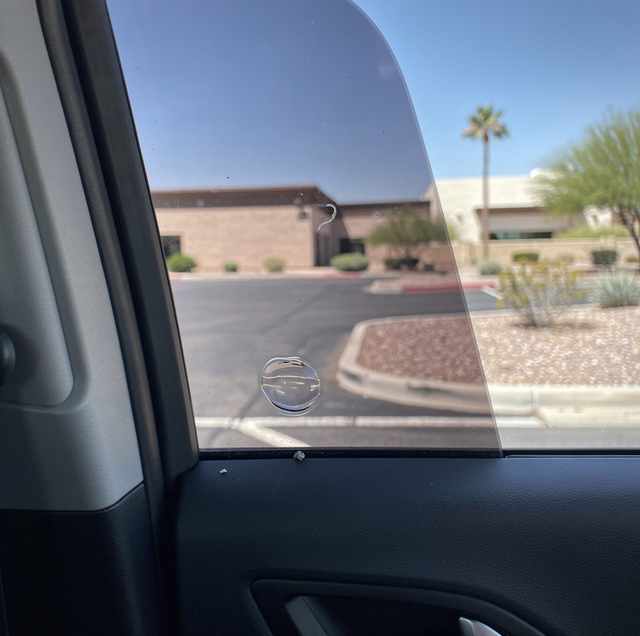
You run a finger across the door glass and feel it before you see it: a scatter of small, raised dots under the tint, catching the afternoon light at an angle that makes them impossible to miss once you know they're there. Or maybe it's one soft, quarter-sized bubble low in the corner of the rear window, right where your hand lands when you look over your shoulder to back out. Either way, the surface that was flat and smooth against the glass now has air, or something else, trapped where it shouldn't be. Whether that means a phone call to the installer or nothing more than a little patience comes down to one question: how old is the film sitting on that glass?
New or Old: Why the Timeline Points to the Cause
Tint film goes onto glass wet. An installer sprays a mounting solution onto both the adhesive side of the film and the glass, lays the film down, and squeegees it flat, pushing excess solution and any trapped air toward the edges. What's left behind isn't a dry bond right away. A small amount of that solution stays trapped beneath the film, against the glass, and it has to work its way out through the film and past the edge seal before the bond is fully set. A scatter of small bubbles that shows up on film that just went on, and then shrinks and flattens out over the days that follow, is that leftover solution finishing its exit. That's a normal part of the process, not a failure.
A bubble on film that's been on the glass for a year or several tells a different story, because by then the mounting solution is long gone. Whatever is trapped under the film at that point got there through a different route, and it isn't going to shrink or disappear on its own the way a curing bubble does. The first thing that determines which situation is in front of you is the film's age: a new film curing or an established film failing.
Moisture Pockets While New Film Cures
Cure time is the period between installation day and the point at which every trace of mounting solution has evaporated, and the adhesive has fully bonded to the glass. How long that takes depends on the film, the adhesive it uses, and the conditions the vehicle sits in afterward, which is why the specific window depends on the installer's own instructions for that job rather than on a single number that applies to every install. Warmth and sunlight both speed the evaporation along, while a shaded, cooler stretch of days slows it down.
Resist pressing or popping a curing bubble with a fingertip or pin. That can shove trapped solution sideways under nearby film instead of out through its own vent path, turning one small bubble into a wider, flatter patch.
During that window, small, evenly scattered bubbles that shrink day over day are exactly what the process looks like while it's still working. What matters is the direction the bubble is moving: shrinking toward flat means the cure is doing its job, while a bubble that stays the same size or grows past the point the installer said to expect it to clear is worth a call back.
Debris Trapped Under the Film at Installation
Not every bump under new film is trapped liquid. A speck of dust, a fiber, or a tiny piece of lint that lands on the glass or the adhesive in the moment between cleaning and laying the film down gets sealed in right along with it. Once that particle is under the film, the squeegee can press the film around it, but it can't press the particle itself flat, so the bump it creates sits exactly where the debris landed.
The distinction that separates this from a curing bubble is that a solid particle can't evaporate and can't pass through the film the way a trapped solution does. A bump that traces back to debris holds its shape and position throughout the whole cure window instead of flattening out, because nothing inside it leaves. Fixing it means lifting that section of film, clearing the particle off the glass, and relaying that piece, not waiting out a cure that was never going to resolve it.
When Adhesive on Older Film Starts to Fail
The bond holding the film to the glass is an adhesive layer, and sustained heat wears that bond over time. On a vehicle parked in summer air above 110°F, sunlit surfaces can run past 160°F, and the film on the glass sits in that heat for stretches of the afternoon, which puts ongoing stress on its bond. In a milder summer climate, with those surfaces running cooler, that stress is smaller.
Once the bond has weakened enough in one area, that patch of film no longer sits flat against the glass. A gap opens between the adhesive and the pane, air finds its way into that gap, and the film lifts into a bubble right over the spot where the bond first gave out. This is the mechanism behind old tint that seems to bubble with age: the glue underneath loses its hold, one small patch at a time.
Cleaning Products and Blades That Damage the Film
Some bubbles trace back to something done to the film after install rather than anything about the film or the install itself. Ammonia-based glass cleaners are the ones that damage film fastest: repeated use weakens the film's adhesive and can cloud dyed film. A window wiped down repeatedly with the wrong cleaner can start to lift or bubble along the film's edge.
A blade or ice scraper is a more direct version of the same problem. Scraping frost or a sticker off tinted glass with a razor can nick through the film's hard coat and into the dye or adhesive layer underneath. That scratch becomes an open door: air and moisture reach the adhesive at that exact point going forward, and a bubble forms centered on the scratch rather than somewhere randomly selected.
Why a Failed Bubble Means Replacing the Whole Panel
A bubble looks like a small, contained problem, which makes patching it sound reasonable. It isn't, for a couple of structural reasons. Cutting into a bubble to let the air out and pressing the film back down leaves a visible seam and a spot where the adhesive underneath is still compromised, since whatever weakened the bond in the first place- heat, a chemical, a scratch- hasn't been reversed by flattening the film back over it. The bubble comes back to the same place because the cause is still there.
There's also a matching issue. Film ages as a set: a patch of film cut fresh and pressed into an older panel won't match the surrounding film's color, clarity, or heat performance after that panel has spent years in the sun, so a visible patch stands out even when it's flat and sealed correctly. Replacing the whole panel resets it to a single piece of film in a single condition, which is the only way to restore the flat, uniform surface the car had on day one.
Frequently Asked Questions
For a water bubble that's still there once the installer-specified cure window has closed, they open a pinhole with a fine needle held at a shallow angle, small enough that it doesn't show, and let the trapped solution or air escape through it. That step is limited to a bubble that's still only water working its way through the cure; it isn't done on a bubble caused by failed adhesive, which needs the film itself addressed instead.
Slip solution still trapped under the film scatters light rather than passing through it clearly, which produces that hazy or milky look. It clears on the same schedule as the bubbles, as the solution finishes working its way out during the cure window.
Hold a light at a low angle to the glass. A debris bump shows a tiny dark speck at its center, while a curing bubble shows a clear film with nothing solid inside.
Not necessarily. Each pane gets its own sun angle and heat load, and the adhesive on each lets go on its own schedule, so one panel can fail while the rest hold.
Yes. Daily heating and cooling cause the glass and the film to expand and contract at slightly different rates, and that repeated flexing loosens more adhesive around the border of an existing weak spot with every cycle. An existing bubble can widen over time through that cycling alone, with no fresh scratch or contamination involved.
Generally, yes. An edge bubble means the adhesive seal at the perimeter has already opened. That opening lets air and moisture continue to work inward under the rest of the panel over time. A bubble that starts over a single piece of debris in the middle of the pane stays limited to that spot because there's no open seam along the edge feeding it.
Book a tint assessment for the bubbled panel — find out whether it clears on its own or the panel needs to come off. Pit Stop Auto Detailing & Vehicle Storage serves Scottsdale, Paradise Valley, Cave Creek, and surrounding areas. Call (480) 660-6270.
