
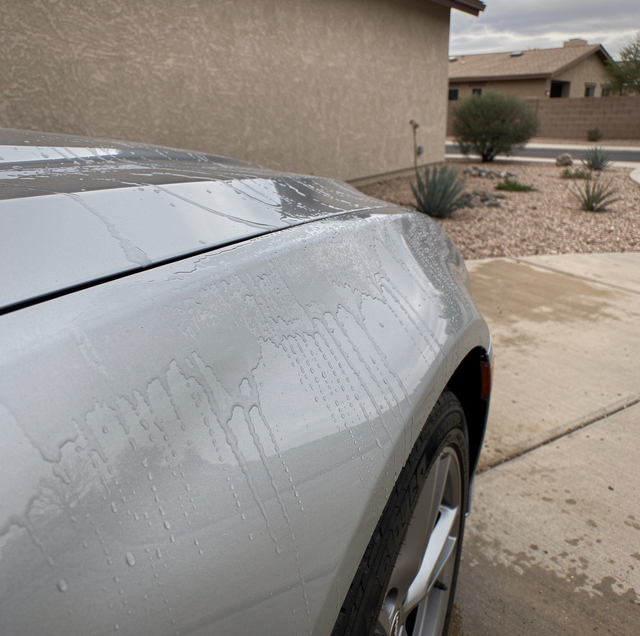
Water beading is the easiest way to check a ceramic coating from across the driveway, but it is also easy to misread. A coating beads because it lowers the surface energy of the clear coat beneath it: instead of spreading out and wetting the paint, water forms tight domes that roll off a tilted panel. That slick surface only works when it is the layer exposed to the water. Anything that settles on top of the coating and stays there- road film, dried mineral spots, a layer of wax or spray dressing- sits between the water and the coating and can flatten the beading the way a worn-through section does. Lost beading by itself does not say which one happened; what changed and where it changed does.
Where and when the beading went missing separates a film on top from wear:
| What You See | Film on Top or Wear |
|---|---|
| Beading gone across the whole car right after a wash | Soap or rinse-aid residue left by the wash itself |
| Beading gone on the hood and roof, still present on the doors | A film sitting on the panels that catch the heaviest airborne buildup |
| Beading gone on the lower doors and rocker panels, still present higher up | Wear from road spray and repeated contact low on the car |
| Water sheeting in blotches instead of beading evenly | A patchy film sitting unevenly across the surface |
| Beading returns after a full decontamination wash | The coating was intact underneath a film the wash removed |
| Paint feels rough to a clean, dry hand | Bonded contamination sitting on top of the coating |
What Makes Water Bead on a Coating
A ceramic coating cures onto the clear coat as a hard, glass-like layer with very low surface energy. Water has to spread across a surface to wet it, and a low-energy surface gives water molecules nothing to grip, so they pull toward each other instead and form a bead. That beading is a byproduct of the coating's chemistry, built in rather than added on, and the same low-energy surface is what lets water and loose dirt release from the paint during a wash. When beading fades, something changed at the surface, either on top of the coating or in the coating itself.
Films That Mask It
A film does not have to be visible to flatten the beading. Road film, a light haze of airborne oil and exhaust residue that settles during highway driving, sits on top of the coating in a layer thin enough to see through but thick enough to keep water from reaching the coating's own surface. Mineral spots left behind when water is allowed to air-dry on the paint instead of being toweled off leave a hard residue in that exact spot, and beading can flatten in the shape of wherever the water sat. Soap residue works the same way on a smaller scale: a wash rinsed too quickly, or a soap loaded with lubricants and conditioners, can leave a film across the whole car that reads as lost beading the next morning, even though nothing happened to the coating underneath. A wax or spray dressing applied over the coating can also change how water behaves, since it becomes the layer water meets.
Wear From Abrasion and Harsh Chemicals
Genuine wear works the opposite direction: instead of adding a layer, it strips part of the coating away. An automated wash running rotating brushes or cloth strips drags grit across the coating on every pass, and that repeated abrasion can thin the cured layer over time. Strong cleaning chemicals attack the coating at a chemical level rather than mechanically, breaking down the same bonds that give the surface its slickness. Even a hand wash carries some of that risk if the wash water is not kept clean, since a technique built around a single bucket can recirculate the grit it just pulled off the car back onto the mitt. Wear like this does not reverse with a wash the way a film does; the coating has to be inspected and, once confirmed thin or gone, recoated or topped, with correction where the paint is marred.
Strong acid and alkaline wheel cleaners can burn skin and eyes, and a hot panel dries them into a concentrated residue. A detailer handles them in gloves and eye protection, on cool panels, and keeps them off the coated paint.
Why Some Panels Lose It First
A coating does not wear evenly across a car, because different panels see different treatment. Horizontal surfaces- the hood, the roof, the trunk lid- collect airborne fallout first, so they can pick up a masking film faster than a vertical door panel simply because more material lands on them. Lower doors and rockers take road spray and heavy wash-mitt contact, which is where wear can show first. Either pattern can show up first without meaning the whole car has lost protection; a coating that still beads well on the roof but has flattened low on the doors is describing contact and spray at that height, not a coating failure across the car.
How a Decontamination Detail Tells Masked From Worn
The clearest way to separate the two is to strip whatever is sitting on top and see what is left. A full decontamination wash, paired with a check for any bonded texture the paint might be holding onto, removes road film, dried mineral deposits, and soap residue in one pass. If beading returns once that layer is gone, the underlying coating was never the problem. If the surface still sheets water after decontamination, especially on a panel that already feels smooth and clean to the bare hand, the coating can be worn through in that spot, and a wash alone does not restore the beading.
Topping or Recoating When the Coating Is Worn
Once wear is confirmed rather than a film, the next step is to correct any contamination or marring on the surface and reapplying protection over it. Correcting the surface means machine-polishing out the marring the coating no longer hides, then cleaning the panel so the new layer bonds to corrected paint. Skipping straight to a fresh topcoat without decontaminating and inspecting the paint first traps the same problem under a new layer.
Frequently Asked Questions
No. A brief rain does not carry the contact time or the mechanical action a wash provides, so a panel that is sheeting water before the rain keeps sheeting through it. A film lifts only with a wash, ideally one that includes a decontamination step, not with rainfall alone.
They can. Door handles, the trunk lip, and the area around the fuel door get touched by bare or gloved hands each time a door, the trunk, or the fuel door is opened, and that hand contact deposits skin oils and grime in a way flat, untouched panels never see. Those spots are worth checking with a clean hand first before assuming the rest of the coating is compromised.
Yes. Glass and interior dressing sprays used during an interior detail can drift onto the trunk lid or the metal trim around the rear glass if a window is cleaned with the trunk open or a door ajar, leaving a light film in that exact spot. It reads as an isolated dead zone in the beading pattern, and it wipes away with a normal wash without needing any coating work.
No. A coating that beads well on some panels and not others is still bonded where it is working, so the fix is decontamination and, if wear is confirmed there, a topper on the affected panels. Stripping and redoing the whole car treats panels that were never the problem.
No, and it does the opposite. A polish works by cutting a thin layer off the surface it is used on, which is how it levels swirls on bare paint, and running that same process over a coated panel cuts through the cured coating itself instead of restoring it. A panel polished this way needs to be treated as bare paint again: cleaned, corrected if needed, and coated from scratch, which is why a coated car is not polished at home.
No, they are two different defects with two different causes. Haze comes from fine scratches or swirl marks sitting in or on top of the cured layer, scattering light, and a hazy panel can still bead water well since the marring does not contact the coating's surface chemistry. Lost beading is a surface-energy problem; haze is an optical one, and fixing one does not fix the other.
Order an exterior detail for your ceramic-coated car — a decontamination wash, bonded-contaminant removal, and a panel-by-panel inspection of the coating. Pit Stop Auto Detailing & Vehicle Storage serves Scottsdale, Paradise Valley, Cave Creek, and surrounding areas. Call (480) 660-6270.
