
Quick Answer: House-wide low pressure comes from something every fixture shares: the municipal supply, a partly closed main or meter valve, a failing pressure-reducing valve, a loaded filter or softener, or a supply pipe narrowed by corrosion and scale.
Low pressure at one faucet and low pressure at every faucet send a plumber to opposite ends of the system. A single weak fixture points at something the size of a coin: a crusted aerator screen, an angle stop under the sink never fully opened, a worn cartridge in one valve body. Weakness that follows you from the kitchen to the shower to the hose bibb has no such explanation, because a blocked screen in the guest bath cannot reach the rest of the house. Saying "it's everywhere" has already done the hardest part of the sorting.
What survives that sort is the short list every fixture shares: the service line off the municipal main, the meter, the main shutoff, whatever pressure control sits behind it, treatment equipment plumbed in line, and the trunk piping feeding the branches. Those parts sit in a fixed order, and each fails in a way that looks different at the tap.
Checking the Supply Before Opening a Wall
Your house gets whatever the utility sends, minus everything the path takes back out of it. Supply pressure varies by neighborhood, ground elevation, and the distribution system zone that feeds the block, so no single number fits every home. Typical residential static pressure is published as a fairly wide band, and a plumber reads yours against the whole band.
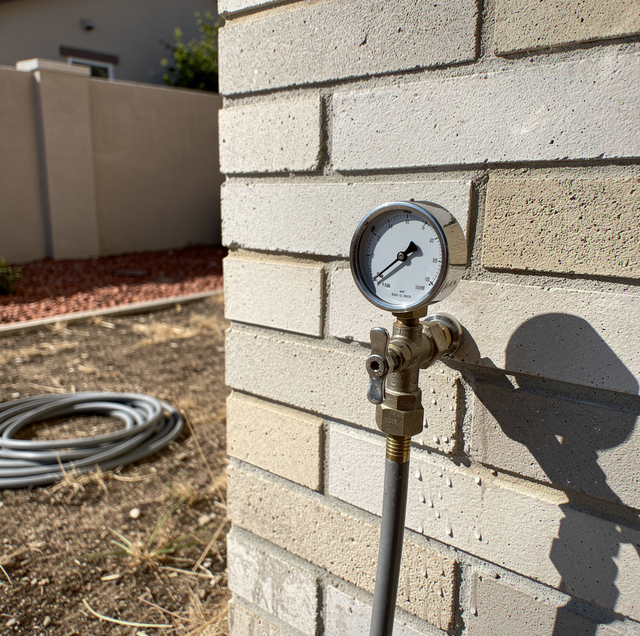
A gauge on the hose bibb: A screw-on pressure gauge at the outdoor spigot nearest where the line enters is an ordinary homeowner tool. Shut off everything running inside, thread it on, open the bibb, and write the number down. Taken before anyone opens a wall, it is the most useful thing you can hand the plumber who arrives.
What the neighbors have: If the houses on either side lost pressure the same week, the cause sits upstream of every valve you own. Utilities replace mains, swap distribution valves, and repair breaks, and what a block receives afterward can settle at a new level.
The clock: Pressure that sags during the heavy-use hours of morning and evening and recovers in between points at demand on a service line that is shared or simply small for what the house asks of it. Pressure equally poor at three in the afternoon and three in the morning has nothing to do with demand, and the search moves indoors.
The Valve Somebody Left Half Turned
Everything entering the house passes a shutoff at the wall and a valve at the meter, both of them untouched for years. The house-side shutoff is located where the supply enters the foundation or wall, often near the water heater. The meter valve belongs to the utility; if the reading points there, it gets reported to them.
A ball valve reads easily: handle parallel to the pipe when open, crosswise when closed, anything between throttling the whole house. The older gate valve fools people. Its wheel can be spun until it feels open while the disc inside still hangs partway down the stream, and on a corroded one the stem can separate from the disc entirely, leaving a handle that turns freely and a gate that never lifts.
Rule this out first when the drop has a date. A water heater swap, a remodel, a branch repair, an irrigation tie-in: each requires closing the main, and each ends with somebody reopening it by feel. If the house was strong Monday and weak Tuesday, and Tuesday is the day a truck sat in the driveway, start there.
The Pressure Reducing Valve and Its Slow Slide
Where street pressure runs high, a house typically carries a pressure-reducing valve: a bell-shaped brass body set into the supply line just past the main shutoff, usually with an adjusting screw and lock nut on top. Street pressure often runs higher than fixtures, supply hoses, and water heaters are built to live with, so the valve knocks it down to a level the house can hold and holds it there as demand rises and falls.
Inside, a spring presses against a diaphragm and a seat, and both wear out. Deposits build on the seat, the diaphragm stiffens and eventually splits, and the valve stops holding its setting. Failure reads two ways. The common one is a slow slide downward: the house feels weaker every few months, nobody can name a day it changed, and every fixture suffers equally. The other is a valve that quits controlling and lets pressure climb back toward what the street delivers. Some wander up and down with no pattern anyone can tie to usage.
The adjusting screw on a pressure reducing valve is not a convenience knob. Turning it without a gauge on the system can push house pressure past what fixtures, supply hoses, and the water heater are built to hold.
Confirming it takes a gauge reading with the valve isolated, held against what the street delivers, and that reading belongs to a plumber who can also set or replace the valve. One near the end of its life holds no setting at all, which is its own answer.
Filters and Softeners That Choke the Flow
Every piece of treatment equipment plumbed into the main line is a deliberate restriction. A whole-house sediment or carbon cartridge works by catching particulate, and the more it catches, the harder water has to push through. Pressure that fades gradually and returns the day a cartridge is changed is that mechanism on a schedule.
A softener adds a resin bed and a control valve to the same path. A unit sized for a smaller home becomes a permanent bottleneck once two or three fixtures run at once. A control valve stuck partway through a cycle holds the bed in a restricted position indefinitely instead of for the few minutes regeneration should take, and a bypass left wrong after service sends water somewhere it was never meant to sit.
Most installations include isolation valves on both sides of the equipment, which makes this the easiest station on the path to prove. A plumber reads pressure ahead of the unit and again behind it, and the difference across the equipment answers the question.
When the Pipe Itself Can No Longer Pass the Volume
Galvanized steel supply pipe fails from the inside out. The zinc lining wears away, the steel beneath it oxidizes, and rust builds into a rough crust that grows inward year after year until the opening left in the middle is a fraction of the original. Older copper reaches the same place by a different route, collecting mineral deposits along the wall and packing them tightest at bends, fittings, and valve bodies where flow already has to work.
This reads as a pressure complaint because a narrowed pipe still delivers water. Open one faucet, and it looks nearly normal. Open a second, and neither gets what it needs, since the pipe cannot pass the volume two fixtures ask for at once. Fixtures farthest from where the supply enters feel it worst.
Whether that pipe gets replaced is a judgment about the condition of the whole system; what determines a pressure complaint is the remaining bore. A pipe can be sound enough to hold water for years and still pass a fraction of what it was built to carry.
When Only the Hot Side Is Weak
Run the cold at a sink, then the hot, and compare. If cold comes out strong and hot comes out weak at every tap, the search stops moving upstream, because everything above the water heater proves itself fine on the cold side. The restriction sits in the heater or the fittings around it.
On a tank heater, that usually means sediment in the bottom, a scaled outlet nipple or heat-trap fitting, corroded galvanized nipples at the top of an older tank, or a cold inlet valve never fully reopened. On a tankless unit, it means scale in the heat exchanger passages or a clogged inlet screen, both of which fight flow before the water gets hot. How long the hot water takes to arrive is set by the volume of cooled water sitting in the pipe between the heater and the tap, so a long wait and full pressure can sit in the same house.
When both sides are weak at every fixture, the heater is cleared, and the answer sits somewhere along the path from the street.
Working the Line From the Street In
Order matters because each upstream station can hide the one below it. From the shower head, a loaded filter looks like a failing regulator, and a drifting regulator looks like a weak street. So the sequence runs from the supply inward: a plumber reads what arrives, confirms the shutoffs are open, isolates the pressure reducing valve, bypasses the treatment equipment, and only then asks what the pipe itself can carry.
| What you notice | Where it points |
|---|---|
| Weak everywhere, hot and cold, at every hour | Something shared by the whole house |
| Neighbors lost pressure the same week | Municipal supply or work on the main |
| Strong midday, weak at morning and evening peaks | Demand on a shared or undersized service line |
| A reading that changes between two gauge checks with nothing running | A pressure reducing valve no longer holding a setting |
| A drop dated to the day plumbing work finished | A shutoff left partly closed |
| Years of slow decline with no date anyone can name | Corroded galvanized or scaled supply pipe |
| Hot weak at every tap, cold strong | The water heater or its fittings |
A leak large enough to weaken an entire house usually announces itself in other ways first, and pinning down where it sits takes listening equipment and section-by-section isolation.
The quickest findings sit at the top of that list. A gate valve three-quarters closed and a filter cartridge four months overdue both look, from the tap, like a house that needs new supply lines. Reading the path from the street inward keeps a valve-handle answer from being mistaken for a repipe.
Frequently Asked Questions
They are measured differently and can disagree. Pressure is the static force in the pipe with everything closed, read on a gauge. Flow is the volume a fixture delivers per minute while running. A house can hold a respectable static reading and still give a disappointing shower, because a restriction shows itself only once water moves. That gap between a good reading at rest and poor performance under load is a telling finding by itself.
Gravity takes a fixed toll on every foot of vertical rise, so an upper floor always sees less than the ground floor of the same house, a gap nobody notices on a healthy system. Once whole-house pressure is marginal, the second floor is where the shortfall shows first, which is why an upstairs shower so often starts the investigation.
Yes, and the usual mechanism is debris. When a utility flushes hydrants or reopens a repaired main, the surge lifts sediment that had been sitting in the distribution pipe and carries it downstream. That material can settle against the screen at the meter or lodge in a valve seat at the house, dropping pressure within hours of work done blocks away.
Sometimes. Many models accept a repair kit that holds the internal cartridge, spring, and seat, a reasonable choice for a young valve with a clean body. On an older one, the brass body is often scaled or eroded around the seating surface, and a rebuilt assembly seated against a damaged body drifts again quickly. Age, condition, and the reading it can hold decide it.
Rarely, and sometimes they sharpen the complaint. Modern fixtures contain flow-regulating inserts calibrated to deliver their rated output at normal supply pressure. When fed to a weak system, those inserts cannot make up the shortfall, and a new fixture can feel worse than the one it replaced. Do fixture swaps after house pressure is corrected, rather than as the correction.
It can. Dishwashers and washing machines fill through solenoid valves that need a minimum inlet pressure to open and admit water on schedule; below it, fill cycles stretch, wash cycles run long, and some machines report a fault. An instant-hot dispenser on the same weak supply behaves erratically too.
Losing pressure at every tap — we gauge the supply, check the shutoffs and the regulator, and tell you which part of the line is holding the house back. Plumbing Professionals serves Pasadena, Altadena, South Pasadena, and surrounding areas. Call (626) 247-3401.