
Why Backflow Preventers Fail Their Annual Test
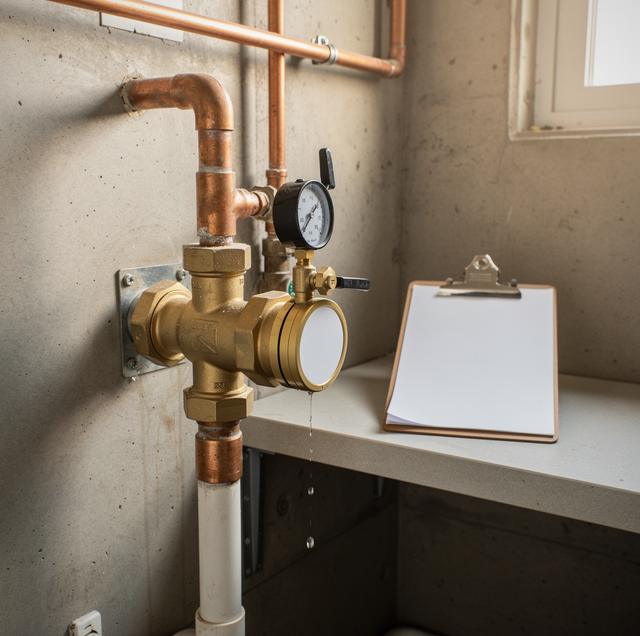
Quick Answer: A backflow preventer most often fails its annual test because debris or grit has lodged in a check valve seat, a rubber seal has worn out from age, or the relief valve is discharging because a fouled check valve is letting pressure through it shouldn't. Only rarely does a failed test mean the entire assembly needs replacing; most failures are repaired with a rebuild kit that swaps the seats, springs, and internal seals a certified technician can access without removing the device from the line. What matters most after a failed test is the compliance clock: most water purveyors set a defined window to repair and retest before the account is flagged.
A backflow preventer's job is simple to describe and easy to take for granted until a test flags it: keep water flowing in one direction only, out toward a fixture, an irrigation system, or a piece of commercial equipment, and never back into the potable supply. Most failed annual tests trace back to something mechanical and fixable, not a sign that anything has actually gone wrong yet. A failed test means the device's internal check valves or relief mechanism aren't holding the required pressure differential, and a certified tester caught it before it became an actual cross-connection event.
What The Annual Test Actually Checks
A certified backflow tester connects a calibrated gauge to a set of test cocks built into the device and runs a sequence of checks specific to the assembly type. For a reduced pressure zone assembly, common on commercial and irrigation systems, that means confirming the first check valve holds against reverse pressure, the second check valve holds independently, and the relief valve between them opens at the correct pressure differential if the first check ever fails, since that relief valve is the backup that vents contaminated water to the outside rather than letting it migrate further into the system. A double-check valve assembly, more common in smaller commercial or residential backflow applications, tests each of its two check valves independently in a similar manner, without the added relief-valve stage.
Every reading gets logged against the manufacturer's minimum differential for that specific model, not a generic pass/fail number, which is why the same test performed on two different assembly types or ages can have different passing thresholds even though the process looks identical from the outside.
The Most Common Reason: Debris In The Check Valve Seat
Water carries fine sediment, and older galvanized supply lines shed even more of it as the pipe's interior corrodes over years of service. That grit travels through the system and can lodge directly in a check valve's rubber seat, the surface the valve disc seals against when it closes. Even a small piece of debris caught in that seat keeps the valve from sealing completely, which shows up on a test as a check valve that won't hold pressure the way it should, even though the valve mechanism itself is otherwise sound.
This is usually the easiest failure to resolve, since it's addressed by disassembling the check valve module, cleaning the seat, and inspecting the disc and spring for wear before reassembly, rather than replacing the whole valve. It's also a failure that tends to recur in a system with an ongoing upstream sediment source, which is worth flagging separately from the backflow device itself if it keeps recurring on test after test.
Worn Seals And Springs From Ordinary Age
Every check valve relies on rubber seals and a spring that maintains tension on the valve disc, and both wear out gradually through normal cycling, opening and closing each time water demand changes in the system. A seal that's hardened or cracked from age no longer conforms tightly to the seat the way a fresh one does, and a spring that's lost tension over years of use may not push the disc closed with enough force to hold against reverse pressure. Neither of these failures happens overnight; they're the reason backflow assemblies have a practical service life even when nothing is visibly broken; the internal components are expected to be rebuilt periodically rather than lasting the full life of the device without service.
When The Relief Valve Is Actually The Problem
In a reduced-pressure zone assembly, the relief valve sits between the two check valves and is designed to open and discharge water if the zone between them experiences an unintended pressure rise, typically because the first check valve is fouled or failing. A relief valve that's discharging, sometimes visibly, sometimes only during testing, is often not the faulty component itself; it's doing exactly what it's supposed to do in response to an upstream check valve problem. Replacing or adjusting the relief valve without addressing why it's discharging in the first place tends to bring the same symptom back on the next cycle.
Freeze Damage And Lack Of Use
In climates with any freeze risk, an unprotected or poorly insulated backflow assembly can suffer cracked internal components from a hard freeze, even when the crack isn't visible from outside the housing. And in any climate, a backflow preventer that sits idle for an extended period, common on an irrigation system that only runs seasonally, can develop a check valve that's slightly seized in position from mineral deposits building up while water sits still in the assembly. Both situations tend to show up as a failed test after a period of inactivity rather than after heavy, continuous use.
Rebuild Versus Full Replacement
Most failed tests are resolved with a rebuild kit specific to the assembly's make and model, containing new seats, springs, and internal seals for the check valve modules and, where applicable, the relief valve. A rebuild is typically done with the assembly still in place on the line, since most models are designed with access covers specifically so a technician can service the internals without cutting the device out of the pipe.
Full replacement becomes the more sensible option when the housing itself is cracked, when the assembly has failed the same rebuild repeatedly within a short span, or when the device is significantly undersized for current demand on the system, something that can happen when a property has added fixtures or expanded an irrigation zone since the backflow preventer was originally sized and installed. A technician who sees a device failing the same way test after test, even after a proper rebuild, is usually looking at one of these underlying situations rather than a repeat of the same simple fix.
The Compliance Clock After A Failed Test
A failed annual test doesn't sit open indefinitely. Most water purveyors set a fixed window, often in the range of 10 to 30 days depending on the jurisdiction, to complete repairs and pass a retest before the account is flagged for non-compliance, which can affect water service in some cases. For a property manager overseeing a commercial account or a building with an irrigation system, that window is the detail that matters most in the days immediately after a failed test notice arrives, since promptly scheduling the repair and retest is what keeps the account in good standing while the actual mechanical fix gets sorted out.
Frequently Asked Questions
No. A failed test means the device's internal components aren't holding the pressure differential they're rated for, which is a mechanical finding, not evidence that contaminated water has actually entered the potable supply. That built-in backstop is also why a reduced-pressure zone assembly is generally the choice for higher-hazard connections and a double-check valve assembly for lower-hazard ones: the RP design has a relief stage to fall back on if a check valve fails, while the DC design does not.
The window varies by local water purveyor, but many set it between 10 and 30 days from the failed test date. Most purveyors also require the passing retest to be submitted directly by the certified tester on a standardized report rather than confirmed verbally by the property owner, so leaving enough lead time for that paperwork to move before the deadline matters as much as scheduling the repair itself.
A rebuild kit resolves most check valve and relief valve failures caused by debris, worn seals, or a weak spring by replacing exactly those components. It also doesn't help once an assembly is old enough that the manufacturer has discontinued rebuild kits for that specific make and model, which happens with older devices and pushes the repair toward full replacement even when the underlying failure would otherwise have been a simple rebuild. A cracked housing from freeze damage or a device that's undersized for current demand points toward replacement for the same reason.
Any connection point where a cross-connection risk exists, including irrigation, a fire sprinkler system, certain commercial equipment, or any process water system, typically requires a backflow preventer regardless of whether irrigation is present. The specific assembly type required usually depends on the degree of hazard the connection presents, which is why a fire line and an irrigation line on the same property can have different backflow assembly types installed.
No, testing is a separate function from installation. A certified tester verifies that the device already installed on the line is functioning within spec; sizing, selecting, and installing the correct assembly type for a given connection is a separate step that occurs once at installation, rather than annually.
Repeated failures of the same type after a proper rebuild often point to something other than normal wear, most commonly an ongoing upstream debris source that continues to foul the valve seat, or a device that's now undersized for demand that has grown since it was installed. Installing a strainer just ahead of the assembly is a common fix for the debris-source version of that pattern, since it catches grit before it reaches the check valve seat rather than only cleaning the seat again after each failed test. When the pattern instead traces back to undersized capacity, a full replacement sized correctly for current use tends to be the more lasting fix than another rebuild cycle.
A failed test notice isn't the emergency it can feel like; it's a mechanical finding that a certified technician can usually diagnose and rebuild in a single visit. The part that actually needs urgency is the compliance clock, so the fastest path back to a passed retest starts with getting that diagnosis scheduled now rather than waiting to see if the notice resolves itself.
Backflow preventer failed its test — get a certified diagnosis and repair before the compliance window closes. Plumbing Professionals serves Pasadena, Altadena, South Pasadena, and surrounding areas. Call (626) 247-3401.
