
Tank vs. Tankless Water Heater: Is Converting Worth It?
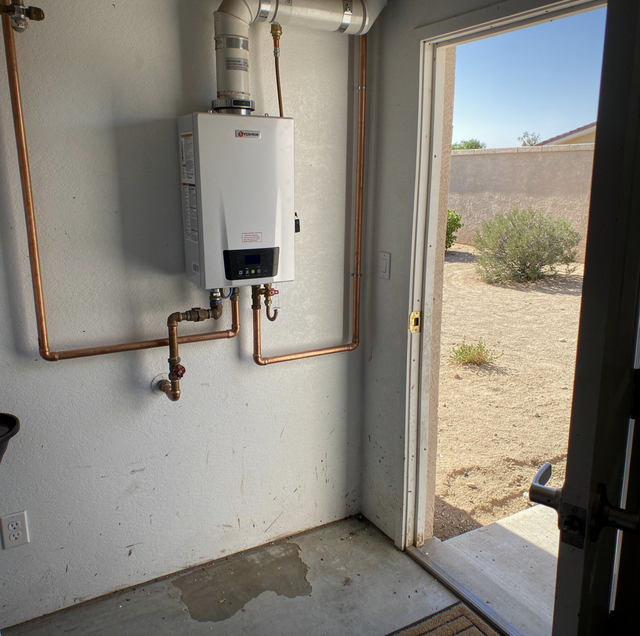
Quick Answer: Converting from a tank to a tankless water heater is worth it for households that want endless hot water and a smaller footprint, but the unit itself is rarely the hard part. The gas line, venting, and sometimes the electrical circuit feeding an older water heater closet were sized for a 30,000- to 40,000-BTU tank, not a 150,000-plus-BTU tankless unit, and getting those three things right is what determines whether the conversion goes smoothly or becomes a bigger project than expected.
A tank water heater fails, or a homeowner simply gets tired of running out of hot water mid-shower, and the tankless option comes up. The unit itself looks like a simple swap on paper: a smaller box, wall-mounted, advertised to run indefinitely. What the sales brochure skips over is that a tankless heater draws far more gas and air than the tank it replaces, and an older home's gas line, vent path, and sometimes its meter were never built to support that jump.
Why The Gas Line Is Usually The First Problem
A standard 40 or 50-gallon gas tank water heater burns around 30,000 to 40,000 BTU per hour. A residential tankless unit sized to cover a whole house typically needs 150,000 to 199,000 BTU per hour, because it has to heat water on demand rather than drawing down a stored reserve. That difference in draw means the existing gas line, often a half-inch pipe run from decades ago, usually cannot deliver enough fuel volume to the new unit even though it physically connects to the same fitting.
Sizing a gas line isn't guesswork; it follows a demand calculation based on total BTU load, pipe length, and the number of fittings between the meter and the appliance. Add a tankless heater's draw to whatever else already runs off the same line- a furnace, a range, a dryer- and the math frequently calls for upsizing a section of pipe to three-quarter inch or larger, sometimes with a dedicated run back closer to the meter rather than tying into the old branch line. In a pre-1970s home, the existing gas line has often been patched or partially replaced over the years, making an on-site assessment more useful than assuming the original pipe run is still intact.
Venting Changes From A Simple Flue To A Sealed System
Most gas tank heaters vent through a Type B metal flue that relies on natural draft, with hot exhaust rising up and out through a shared or dedicated chimney. Tankless units are built differently: they're sealed-combustion appliances, drawing combustion air in through one pipe and pushing exhaust out through another, almost always PVC, CPVC, or stainless steel rather than the old sheet-metal flue.
That means the old vent path usually gets abandoned rather than reused. The new venting needs a clear route to an exterior wall or the roof, with specific clearances from windows, soffits, and property lines that don't always align with where the original heater closet is located. In a tightly built older home, especially one with a heater tucked into an interior closet or a garage corner without an easy path outside, running new intake and exhaust pipe can mean more cutting and patching than replacing the unit itself. Some homes end up with the new unit relocated entirely closer to an exterior wall, rather than reusing the original closet, once the venting path is mapped out.
Electrical And Water Quality Details That Get Missed
A gas tank heater generally needs no electrical connection at all. A tankless unit requires power for its control board, ignition system, and internal sensors, so an available outlet or a new dedicated circuit near the unit is needed. That's a small addition on its own, but it's one more line item that a quote focused only on the heater itself can leave out.
Hard water is the other factor that shows up later rather than at install. A tank heater can tolerate scale buildup for years because it has a large reservoir and a sacrificial anode rod that absorbs corrosion. A tankless unit runs water through narrow heat-exchanger passages, and in a hard water area those passages scale up faster, which is why manufacturers specify a periodic descaling flush, typically circulating a vinegar or citric acid solution through the unit with a small pump, as a condition of keeping the warranty intact. Skipping that flush schedule is one of the more common reasons a tankless unit loses output well before its rated service life.
What Changes Day To Day After Conversion
The most noticeable difference is supply, not speed. Hot water still takes roughly the same amount of time to travel from the heater to a distant fixture, since that's a function of pipe length, not the heater type. What changes is that the tap doesn't run cold after fifteen or twenty minutes the way a tank's stored reserve eventually does.
The trade-off is simultaneous demand. A tank heater draws down a large reserve regardless of how many fixtures run at once, so three showers running together simply pulls the tank down faster. A tankless unit is rated by flow rate, gallons per minute it can heat to target temperature, and running several fixtures at once can exceed that rating, especially during cold-water-supply months when the unit has to raise the temperature by more degrees. Homes with heavy simultaneous demand sometimes need a larger single unit or two units installed in parallel, rather than assuming that any tankless model will serve any household equally.
Sizing For Larger Households
Flow rate on a residential tankless unit typically ranges from about 5 to 10 gallons per minute, with the higher end reserved for larger units with the highest gas draw. A shower and a dishwasher running together might pull three to four gallons per minute combined, which most single units handle without trouble. Add a second shower and a washing machine to that mix on a cold winter morning, and combined demand can exceed what a single unit is rated for, causing the water temperature to drop rather than the unit simply running out of water. Larger households sometimes solve this by installing two smaller units in parallel rather than one oversized unit, which also builds in a backup if one unit needs service.
Comparing Tank And Tankless For A Conversion
| Factor | Tank Water Heater | Tankless Water Heater |
|---|---|---|
| Typical gas demand | 30,000-40,000 BTU/hr | 150,000-199,000 BTU/hr |
| Gas line requirement | Usually fits existing half-inch line | Often needs upsized line, sometimes a new run |
| Venting | Type B flue, natural draft | Sealed combustion, dedicated intake/exhaust pipe |
| Electrical need | None for most models | Dedicated outlet or circuit for control board |
| Hard water impact | Scale settles in tank, anode rod absorbs some corrosion | Scale narrows heat-exchanger passages, needs periodic flush |
| Simultaneous demand | Limited by stored reserve, all fixtures draw from same tank | Limited by flow rate rating, may need two units for heavy demand |
| Expected service life | Roughly 8-12 years | Roughly 15-20 years with maintenance |
| Footprint | Floor space in closet or garage | Wall-mounted, frees floor space |
Where The Conversion Pays Off
The unit swap alone rarely justifies the disruption of upsizing a gas line and rerouting venting. What makes the conversion pay off is the combination: a household that's outgrown its tank's recovery rate, a home where floor space in the heater closet or garage has other uses, and a gas and vent path that can be upgraded without major demolition. A single-story home with an exterior wall near the existing heater location is a much easier conversion than a heater tucked deep in an interior hallway closet with no nearby path outside.
Age of the existing system matters too. A tank heater already near the end of its service life is a natural time to switch, since the gas line and venting work has to happen regardless of which type of unit gets installed once the fuel and air supply are inadequate for a bigger appliance. Converting proactively, before a failure forces a same-day replacement, also allows time to properly size the gas line and venting rather than rushing a temporary fix under pressure.
Frequently Asked Questions
Yes. Any gas line modification and any change to venting requires a permit and inspection in nearly every jurisdiction, separate from any permit tied to the water heater itself. Skipping that step leaves no record that the gas line was pressure-tested and the venting was installed to code, which matters at resale and for insurance purposes.
Sometimes. If the total connected gas load for the home, including the new tankless unit, exceeds the existing meter's rating, the utility may need to swap in a larger meter before the appliance can be commissioned. This is a separate step from the interior gas line work and is worth confirming early, since it can affect scheduling.
A conversion with an accessible exterior wall and adequate existing gas capacity often takes a single day. Add gas line upsizing, new venting through a difficult path, or an electrical circuit addition, and the job can extend to two or three days once permitting and inspection scheduling are factored in.
Not always, but manufacturers in hard water regions frequently require periodic descaling as a condition of the warranty, typically an annual flush, whether that softening comes from a whole-house softener or a scheduled service visit. The two options aren't identical in what they protect: a flush routine only keeps scale out of the tankless unit's heat exchanger, while a whole-house softener also slows scale buildup in the supply pipes, fixtures, and valves throughout the rest of the home. Skipping both increases the odds of reduced flow and efficiency loss inside the heat exchanger well before the rated service life is reached.
The abandoned flue is typically capped or removed rather than reused, since a sealed-combustion tankless unit's intake and exhaust piping have a different diameter and material than the old Type B vent. Leaving an old flue connected but unused isn't a safety issue on its own, but it should be properly sealed to prevent pests or moisture from entering the wall or attic space.
Often, yes, since lower overall demand means a single, moderately sized unit can usually keep pace without the simultaneous-demand issues that arise in larger households running multiple showers, a dishwasher, and a washing machine at once. A smaller household sometimes qualifies for a model near the lower end of the 150,000 to 199,000 BTU range, which occasionally lets the existing gas line handle the load without upsizing, though that still has to be confirmed with a demand calculation rather than assumed from the bathroom count alone.
Before scheduling a conversion date, ask for a walkthrough of the gas line, the venting path, and the electrical connection specifically, not just a quote for the unit itself. Whichever of those three ends up needing the most work sets the timeline, and knowing that answer ahead of time turns a tankless conversion into a planned project rather than a same-day estimate that grows once the walls are opened.
Considering a tankless conversion? Find out what your gas line and venting can actually support. Plumbing Professionals serves Pasadena, Altadena, South Pasadena, and surrounding areas. Call (626) 247-3401.
