
What Is Hydro Jetting and When Your Drain Actually Needs It
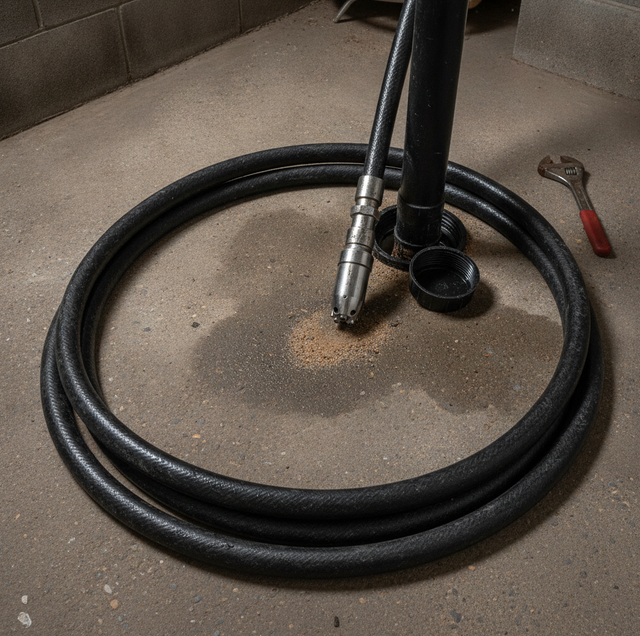
A drain that clogs, clears, and clogs again in a few weeks is trying to tell you something. The blockage you keep fighting is usually a symptom, not the whole problem, and the tool most homeowners reach for only treats the symptom. Hydro jetting is the method that goes after the underlying buildup, and understanding how it works makes it easier to know when it's worth calling for and when a simpler fix will do.
How Hydro Jetting Actually Works
Hydro jetting cleans a drain or sewer line with water, but not the trickle that comes out of a garden hose. A machine pressurizes water and sends it through a dedicated hose fitted with a specialized nozzle. That nozzle is the whole point of the process. Instead of one straight stream, it splits the flow into several jets aimed in two directions at once.
The forward-facing jets do the cutting. They punch into the clog and break it apart so the debris can move down the line. The rearward-facing jets do two jobs at the same time. They push against the pipe wall to drive the hose forward and up the line, and they blast the inside surface of the pipe as the hose travels, scouring off whatever is stuck to the walls. That backward thrust is why the operator doesn't have to force the hose in by hand, the way you would a cable.
The pressure involved is substantial, commonly reaching several thousand psi, often in the neighborhood of 3,500 to 4,000. That number is what separates jetting from every drain remedy you can do yourself. At that pressure, water stops behaving like a rinse and starts behaving like a cutting tool, which is exactly what a coating of hardened grease or mineral scale requires.
What Jetting Removes That a Cable Can't
Here is the difference that matters most. Run a cable auger down a clogged line, and it does one thing: it bores a hole through the obstruction. Water starts flowing again, the drain seems fixed, and the actual problem, the layer of gunk lining the pipe, is still there. The auger left a tunnel through it.
Take a kitchen drain that has collected years of cooking grease. Fats pour down warm and liquid, then cool and congeal against the pipe wall, trapping food particles and slowly narrowing the opening, the way plaque narrows an artery. A cable can poke through the middle of that mass. It cannot strip it off the walls. Within weeks, the narrowed opening closes back up, and you are snaking the same drain again.
Jetting solves the actual problem because the rearward jets scour the full inside diameter of the pipe. The line comes back closer to its original bore, not just with a fresh hole in the clog. That is why jetting handles the buildup a cable leaves behind:
- Hardened grease and fat coating kitchen and laundry lines
- Sludge and soft organic buildup that settles along the bottom of a slow line
- Mineral scale that crusts onto the pipe wall over time
- Fine tree roots that have worked in through joints, which the jets can cut and flush out
That last one has limits worth naming. Jetting can clear fine, hairlike root intrusion and wash it out of the line. A mature root mass, the diameter of the pipe is a different situation and usually points to a repair, not just a cleaning.
When You Actually Need Hydro Jetting
Not every clog calls for this. A single toilet backup or a bathroom sink that drained fine until yesterday is a localized problem, and a cable often handles it faster and with less setup. Jetting earns its place when the pattern points to a buildup rather than a one-time obstruction.
Reach for jetting when you see:
- Clogs that keep coming back in the same line, no matter how often you clear them, which almost always means a coated pipe rather than a fresh blockage each time
- A grease-choked kitchen line, especially in a home that cooks often or a restaurant where fats, oils, and grease enter the drain daily
- A whole-house slowdown, where several fixtures drain sluggishly at once, pointing to buildup in the main line they all share
- Fine root intrusion confirmed on camera, where roots have found their way in through pipe joints
- Scheduled maintenance on a line with a known history of fouling, cleaning it on a set interval before it backs up
The common thread is that jetting treats conditions, not incidents. If the same drain has a recurring story, jetting is usually the tool that ends the cycle.
Why the Camera Comes First
There is a step that has to happen before the jetter ever runs, and skipping it is the fastest way to turn a cleaning into a disaster. A plumber sends a camera down the line first to inspect its condition.
The reason is the pressure. The same force that strips grease off a healthy pipe can finish off a failing one. A line that is cracked, badly corroded, or already partly collapsed may not survive several thousand psi. Older clay, cast iron, and Orangeburg pipe are especially vulnerable, and their weak points are invisible from above ground. Jetting a fragile line can widen a crack, break a compromised section, or push a marginal pipe into full collapse.
The camera settles the question before any water pressure is applied. It shows what is causing the blockage, whether roots, grease, scale, or a broken section, and it shows whether the pipe walls are sound enough to take the work. If the pipe is intact, jetting proceeds with confidence. If the camera finds a break or advanced deterioration, the answer is a repair, and jetting that section would have made things worse. The inspection is what makes the whole process safe rather than a gamble.
Snake Versus Jetting, Side by Side
Both tools have a job, and the right one depends on what you are dealing with.
A cable auger, the snake, is the right choice for a single localized clog or for hooking out a solid object, a wad of wipes, a lodged toy, or a dense hairball. It grabs and pulls, or it drills through, and for a one-off obstruction, that speed is exactly what you want.
Hydro jetting is the right choice when the issue is a coating rather than an object: grease, scale, sludge, or fine roots spread along the pipe, and any situation where you want the full line cleaned rather than one plug cleared. The snake makes water flow again. The jetter makes the pipe clean again. They are answers to different questions, and a good plumber picks based on what the line actually needs.
Why This Is a Professional Job
Hydro jetting is not rental-counter equipment for a Saturday afternoon. Water at several thousand psi is truly dangerous to handle, capable of serious injury if the hose is mishandled or the nozzle turns the wrong way. Beyond the safety side, the work depends on judgment a machine can't supply: choosing the correct nozzle for the pipe and the type of blockage, reading the camera footage to confirm the pipe can take the pressure, and knowing when the line calls for repair instead. Those decisions are what protect the pipe. Done right, jetting restores a line to near its original flow. Done blindly, on the wrong pipe, it does damage that a cable never could.
Frequently Asked Questions
A cable auger punches a hole through a clog to get water flowing again, but it leaves the pipe wall coated. Hydro jetting blasts the full inside diameter of the pipe clean with high-pressure water, so it removes the grease and scale lining the walls that a snake bores straight past. Jetters are rated by two numbers, not one: the psi cuts the deposit, but the flow in gallons per minute (GPM) is what actually flushes the loosened debris out of the line, so both figures matter when a plumber sizes the machine to the pipe.
Hardened grease, sludge, mineral scale, and fine tree roots. The water jets scour the pipe wall all the way around instead of just boring through the center of the blockage, so material bonded to the surface comes off rather than being tunneled through. It has a firm limit worth knowing: jetting will not clear a fully collapsed pipe or push out a solid foreign object like a lodged tool or a wad of wipes. Those call for a snake to hook the object or excavation to replace the crushed section, not more pressure.
The pressure typically runs about 3,500 to 4,000 psi for residential lines and higher for commercial work, matched to the pipe and the type of buildup. The water travels through a nozzle that sprays forward to break the clog and rearward to drive the hose up the pipe and scrub the walls as it advances, which is how one pass both clears and cleans the full inside diameter.
Not always, which is why a camera inspection comes first. A cracked, corroded, or collapsing line can be damaged further by the pressure, so the pipe's condition is confirmed before any jetting rather than assumed. Cast iron worn thin by rust and Orangeburg pipe, a tar-paper pipe used in mid-century construction that softens and deforms with age, are the two most likely to be too thin to jet safely, and the camera is what confirms whether the wall can take the work. On a sound pipe, it is safe; on a failing one, it can cause a collapse.
To see what is causing the blockage and whether the pipe can handle the pressure. The camera reveals roots, grease, scale, or a broken section, and that determines whether jetting is the right tool or whether a repair is needed instead. Many camera heads also carry a locator, a small transmitter called a sonde, so the plumber can trace it from above ground and mark the exact spot and depth of a break on the surface, separate from just spotting the clog, which is what lets a repair dig in one precise place instead of trenching the whole run.
It depends on the line. A home with repeated grease clogs or a history of roots may benefit from periodic maintenance jetting on a set interval, while a line that rarely clogs is jetted only when a problem shows up. How fast the pipe fouls sets the schedule, not a fixed calendar rule.
Book a camera inspection and hydro jetting — get your line cleaned right the first time and stop fighting the same clog. Plumbing Professionals serves Pasadena, Altadena, South Pasadena, and the surrounding areas. Call (626) 247-3401.
