
What a Backwater Valve Does to Stop Sewage Backups
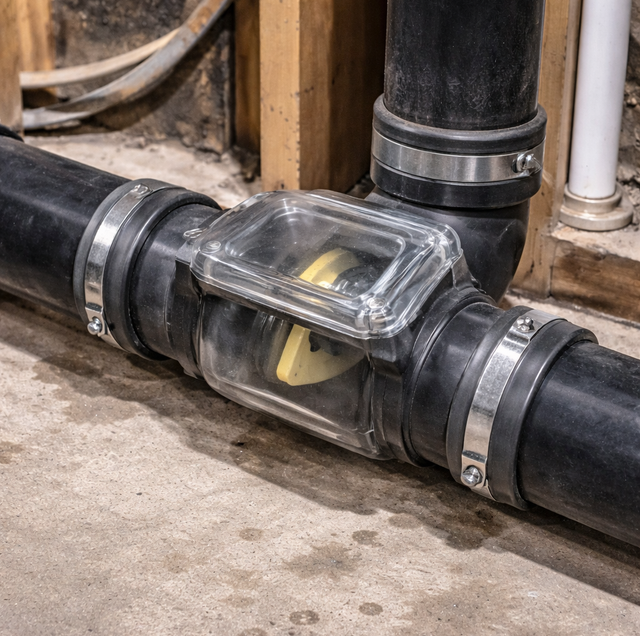
Quick Answer: A backwater valve is a one-way flap in the main sewer line that opens to let waste flow out and snaps shut when sewage tries to flow back in, keeping it from surfacing through low drains and fixtures.
A backwater valve is a one-way gate installed in your home's main sewer line. It sits between your house and the municipal sewer, and its job is simple: let wastewater leave and stop anything from coming back the other way. Under normal use, waste flows out toward the street and the valve stays open. If pressure ever reverses in the public sewer, the valve closes and blocks that flow from reaching your drains.
That reverse-flow protection matters because the alternative is ugly. When a city sewer or a blocked line pushes waste backward, it looks for the lowest opening in your plumbing and comes up through it. Without a barrier, that opening is a floor drain, a basement toilet, or a shower on a lower level. A backwater valve gives the reversing flow something solid to push against instead.
How the One-Way Flap Works
At the center of the valve is a hinged flap, sometimes called a flapper or gate, set inside a housing that splices into the sewer pipe. The flap hangs at an angle and is designed to rest open during normal drainage. Water, waste, and air move past it freely on their way to the street, so your fixtures drain the way they always have. You would not notice it doing anything at all.
The moment flow tries to move the wrong direction, physics does the work. Reverse flow pushes the flap toward its seat rather than away from it, and the flap swings closed and presses against a machined rim. The harder the backflow pushes, the tighter the seal becomes. There is no motor, no electricity, and no sensor. It is a mechanical check that responds to the direction of the water itself, which is part of why a well-maintained unit is dependable.
Most residential models are made of durable plastic or ABS with a clear or removable cover so the flap can be seen and reached. Many include small floats on the flap that help it lift and close cleanly. Because the mechanism is passive, the flap's freedom to move is everything. Anything wedging it partly open defeats the seal, which is why inspection is not optional.
Why Sewage Backups Happen
Backups come from a few directions, and heavy rain is only one of them. A backwater valve is worth understanding as protection against all of them, not a single weather event.
The public sewer surcharges: City sewer mains are sized for typical daily flow. During an intense storm, stormwater and groundwater can enter the system faster than it drains, and the main fills past capacity. That is called a surcharge. When the public line is full and pressurized, it can push waste back up the lateral toward every home connected to it. This is the classic case a backwater valve is built for.
A blockage forms downstream: A clog does not need a storm to cause trouble. Tree roots working into a pipe joint, a collapsed section of old clay or cast iron, grease buildup, or a foreign object can throttle the line. Once flow is restricted downstream of your fixtures, the next thing you send down the drain has nowhere to go and can rise back up.
Low fixtures sit in the danger zone: Any fixture below the level of the street is most exposed, because backflow follows gravity to the lowest exit. A basement bathroom, a floor drain in a lower level, or a laundry standpipe below grade will flood first. Fixtures on upper floors usually sit high enough to stay clear, which is why the risk is so concentrated at the bottom of a house.
Where the Valve Is Installed
A backwater valve is placed in the main sewer line, on the house side of the connection to the public sewer, so it protects the whole home at once. In many installations, it sits in an accessible pit or box in the basement floor or in the yard, fitted with a cleanout cover that lifts off for service. That access is deliberate: the flap has to be reachable for cleaning and inspection, and the cleanout doubles as a port for clearing the line if it ever needs to be augered.
Getting it in place is real plumbing work. Installation means cutting into the main line, fitting the valve body so flow direction is correct, and sealing the connections. In existing homes, that often involves breaking a section of floor or excavating outside to reach the pipe. Because it ties into the sanitary sewer, this work usually requires a permit and inspection, and the specific rules vary from one jurisdiction to the next. It is not a project to improvise, and it is not a fixture-store part you drop in yourself.
Backwater Valve Versus Sump Pump
These two get confused constantly, and mixing them up leaves a home half-protected. They guard against different water and work in opposite ways.
A sump pump handles groundwater. It sits in a pit that collects water seeping up around the foundation, and when the pit fills, a float switch turns on a pump that lifts that clean-ish water up and out of the house. It is active, powered, and always ready to move water away.
A backwater valve handles sewage. It is passive, has no pump, and does not move water at all. It only blocks contaminated flow from re-entering through the sanitary line. A home in a flood-prone spot with a below-grade bathroom may well need both: a sump pump to manage seepage and a valve to stop sewer backflow. One does not substitute for the other, so treat them as separate lines of defense.
Maintenance and Inspection
A backwater valve protects you only while the flap can move and seat cleanly, so periodic attention is the whole game. Over time, wipes, grease, hair, and grit can collect on the flap or its seat. If debris holds the flap even slightly open, reverse flow slips past the gap, and the protection quietly fails, usually right when a surcharge finally tests it.
Servicing is not complicated for a plumber. The cleanout cover comes off, the flap and seat are wiped clean, the hinge and any floats are checked for free movement, and the rubber seal is examined for wear or cracking. A worn seal or a stiff hinge gets replaced before it becomes a failure. A reasonable habit is an inspection about once a year, and sooner if you have had backups before or the line is known to catch roots.
Keeping a note of where the access cover is saves time when someone needs to reach the flap fast during an event.
Two safety points sit alongside maintenance. And a valve doing its job creates a temporary trap: while it is closed against a surcharge, anything you drain has nowhere to go and will back up inside the house. During a known event, hold off on running water, flushing, and laundry until the public line drops and the flap reopens.
Sewage is a biohazard, so any backup that gets past a valve should be handled with gloves, ventilation, and proper cleanup rather than a bare-handed mop.
Signs You May Want One
Some homes are clear candidates. If your home has backed up through a low drain even once, that is the strongest signal, because a line that surcharged or blocked once can do it again. A basement or below-grade bathroom, a floor drain that sits lower than the street, or a lower-level laundry all raise the odds enough to be worth a conversation.
Neighborhood history counts too. If nearby homes on the same municipal line have flooded during big storms, your lateral connects to the same main and shares the same surcharge risk. Older sewer laterals prone to root intrusion add a second, weather-independent reason. A plumber can camera the line, confirm where a valve would sit, and tell you whether your setup is a strong fit before anyone cuts concrete.
Think of the valve as a seatbelt for your sewer line: invisible most days, doing nothing you notice, and the one thing you are grateful for on the rare day flow tries to come the wrong way. It does not stop the storm or fix the city main. It just makes sure their worst moment does not become a flooded floor in your home.
Frequently Asked Questions
A properly sized valve should not slow normal drainage, since the flap rests fully open under outbound flow. Occasional gurgling can appear if the flap needs cleaning or if the line has a venting issue, which is worth having checked. Some installers pair the valve with an added vent so air moves freely and the flap seats without drawing water from nearby traps.
Hold off if you can. A storm surcharge usually keeps the flap shut for only a short window, often under an hour, but it reopens on its own the moment the public line drops, so there is no lever to reset. One nuance: fixtures that sit physically above the street's flood level, such as an upstairs bathroom, can still drain during a closure because gravity carries that flow out ahead of the valve, while basement and ground-floor fixtures below street level are the ones that will back up. If you are unsure which of your fixtures sit above that line, a plumber can mark them so you know what stays usable in an event.
The valve body often lasts for decades, but the wearing parts are the rubber seal, the hinge, and any floats on the flap. Those soft components can stiffen, crack, or wear a groove over years of contact, which is exactly what a routine inspection catches. Replacing a worn seal is minor compared with letting a failed seal pass backflow unnoticed.
The same one-way principle applies, but placement differs, and a valve interacting with a septic tank and its own venting needs a plumber who accounts for the tank layout. On a septic system, the concern is usually a blockage or a saturated drain field rather than a municipal surcharge. The right position and type depend on the specific system, so it is not a drop-in choice.
Most common units are normally open, resting open and closing only against reverse flow. A normally closed design stays shut and opens only when your fixtures actively push water out, then reseals. Normally closed types can offer tighter protection for a fixture that sits very low, but they demand more careful maintenance because a sticky flap can slow ordinary drainage.
Requirements vary widely by jurisdiction and insurer, and some areas offer incentives for installing one after a recorded backup while others simply recommend it. Because rules and any inspection steps differ locally, confirm the current expectations before scheduling work. A licensed plumber pulls the permit and handles the inspection so the finished installation meets whatever the local authority expects.
Ask about a backwater valve before the next big storm — protect your lowest drains from a sewage backup. Plumbing Professionals serves Pasadena, Altadena, and Arcadia. Call (626) 247-3401.
