
Pipe Bursting: Replace a Sewer Line Without Digging
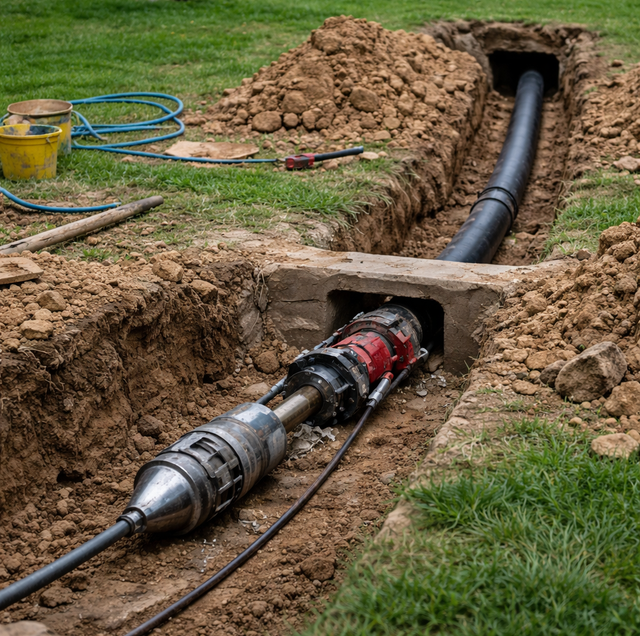
Quick Answer: Pipe bursting replaces a broken underground sewer or water line without digging up the whole run. A cone-shaped bursting head is pulled through the old pipe, splitting it outward into the soil while towing a new pipe in behind it. Two small access pits, one at each end, are all the digging most jobs need.
Your sewer line runs several feet under the yard, and when it fails, the old fix was blunt: rent a backhoe, trench the whole run, and rebuild the lawn afterward. Pipe bursting is the trenchless alternative. It replaces a failed underground pipe by destroying the old one in place and pulling a new one into the same path, using two small holes instead of one long trench. Understanding the burst-and-pull idea first makes the rest of the process easy to follow.
The Burst-and-Pull Idea
The core of pipe bursting is a single motion that does two jobs at once. A pointed steel head, wider at the back than at the front, gets pulled through the inside of the failed pipe. As that cone forces its way along, it splits the old pipe walls and shoves the fragments outward into the surrounding dirt, making just enough room. Fastened to the back of that head is a brand-new pipe, so as the head advances, it drags the replacement line into the void it just created.
By the time the head reaches the far end, the old pipe is gone as a functioning line, its pieces are compacted into the soil around the bore, and a fresh, continuous pipe sits exactly where the old one used to run. Nothing had to be dug up along the length of the run to make that swap happen. That is the whole trick, and every step below is just the setup and machinery that make this one pull possible.
A good way to hold the picture in your head: it is like threading a new bootlace by tying it to the frayed old one and pulling, except the tool clears and widens the eyelet on its way through instead of following an open path.
How Pipe Bursting Works, Step by Step
The job breaks into a few distinct stages, and each one sets up the pull.
Inspection and locating come first: Before any equipment shows up, a plumber runs a camera down the line to confirm what is actually wrong, how far the damage runs, and whether the pipe still holds a usable path from one end to the other. At the same time, buried utilities get located and marked. Calling 811 to have gas, electric, water, and communication lines flagged is not optional, because the bursting head travels blind through soil that may hold other lines nearby.
The cable or rod goes through: A steel cable or a string of rigid rods is fed through the old pipe from one pit to the other. This is the guide the whole operation follows. On smaller residential jobs, the pulling is done with a cable and a winch; on larger or more stubborn runs, segmented pull rods are used because they resist buckling under heavy force.
The bursting head and new pipe are attached: At the exit pit, the cone-shaped bursting head is connected to the cable or rod. The leading edge of the new pipe, most often high-density polyethylene, is fastened to the trailing end of that head. HDPE gets used because it arrives in long fused lengths with no joints along the run, so once it is in the ground there are no couplings to leak or let roots back in.
The hydraulic winch does the pulling: A hydraulic winch or a pulling unit set at the receiving pit reels the cable in under high tension. That force drives the head through the old pipe, splits it, and tows the new line behind it in one continuous draw. The plumber watches tension and pull speed the whole time so the head tracks the original path and the new pipe feeds in evenly without kinking.
Reconnection and check: Once the new line is fully through and positioned, the crew reconnects it to the house side and the main or septic side, then runs the camera again to confirm the new pipe is clean, aligned, and flowing. The two pits get backfilled, and the surface is patched.
The Two Access Pits
Instead of one long trench, pipe bursting needs two compact holes. The entry pit sits at one end of the run, and the exit pit sits at the other. One pit gives the bursting head and new pipe a place to enter the ground; the other houses the winch and gives the head somewhere to emerge. On a typical home job, these pits are dug where the line meets the house foundation and out near the property line or main connection, so most of the lawn, driveway, patio, and mature plantings in between are never touched.
Their size depends on depth and pipe diameter, but they are measured in a few feet, not the length of the yard. That contained footprint is the practical payoff of the whole method.
When Pipe Bursting Is the Right Call
Pipe bursting earns its place on specific kinds of failures.
A fully collapsed or badly broken line: When a pipe has crushed, cracked open, or sheared at joints, there is nothing sound left to work with from the inside. Bursting replaces the pipe outright rather than trying to rehabilitate it.
Old material that has reached the end of its life: Vitrified clay that has cracked and let roots in, cast iron that has scaled and corroded, and Orangeburg (a tar-impregnated fiber pipe) that has softened and deformed are all common candidates. These are replacement problems, not repair problems.
Upsizing: Because the head clears its own path, it can pull in a pipe one size larger than the original. A home that has outgrown an undersized line, or a property adding fixtures, can gain capacity without a wider trench.
How It Differs From Pipe Lining
Pipe bursting and pipe lining are both trenchless, and people mix them up, but they solve opposite problems. Lining, often called cured-in-place pipe, threads a resin-saturated felt sleeve inside the existing pipe and cures it hard, forming a new pipe within the old walls. That only works if the host pipe is still mostly intact and holds its shape, because the liner needs those walls to press against.
Bursting is for the pipe that is too far gone for a liner to grip. It does not coat or reinforce the old pipe; it destroys it and installs a fresh one. Lining also slightly narrows the inside diameter, while bursting can hold the diameter or increase it. A camera inspection is what tells a plumber which of the two a given line actually needs.
How It Differs From Open-Trench Digging
Open-trench replacement exposes the entire pipe by excavating the full length of the run. It is the most direct method and sometimes the only workable one, but the cost lands on the surface above: torn lawn, cut driveways or walkways, disturbed patios, and removed shrubs, all of which have to be rebuilt afterward.
Pipe bursting reaches the same underground pipe while disturbing only the two pit areas. Less surface restoration usually means the work finishes faster and the yard recovers sooner. The finished result is comparable: a full new line, but the path to it is far gentler on everything sitting on top of the ground.
The Limits Worth Knowing
Pipe bursting is not a fit for every situation, and an honest assessment names the constraints.
It needs room for the pits and a clear pulling path, so tight or heavily built-over sites can rule it out. It has to be done carefully near other buried utilities, because the outward-splitting force can disturb a line running close alongside; this is exactly why locating and marking come first. And the method depends on a usable path through the old pipe. A line that has collapsed flat, separated and offset badly, or bellied into a low spot may not give the head a route to follow, and those cases can still require excavation at least where the failure sits.
Pipe bursting is specialized, heavy-equipment work. Between the hydraulic pulling forces, the buried-utility hazards, and raw sewage as a biohazard, it is not a do-it-yourself project.
Frequently Asked Questions
Both. It is most common on gravity sewer laterals, but the same pull-through method installs new water service lines, which is often called pipe splitting when the goal is replacing an old galvanized or lead service line with HDPE. The main difference is that a pressurized water line then gets pressure-tested before it is put back in service, a step a gravity sewer line does not need.
They stay in the soil. The bursting head compacts the broken pieces outward into the trench wall as it passes, so the shards become part of the compacted bore around the new pipe rather than being pulled back out. With old clay, this crumbles into small pieces; brittle cast iron shatters similarly. Ductile iron is an exception that often resists splitting and may need a different approach.
Long, gentle runs burst best. A sharp bend or an angled fitting can stop the head from tracking cleanly, so a crew may add a small intermediate pit at a problem joint or sweeping bend to keep the pull true. That is one reason the camera inspection maps the whole route before a pull is planned.
Many single-family sewer laterals are burst and reconnected in one day once the pits are dug, because the actual pull through the old pipe takes only a short stretch of that time. Deeper lines, longer runs, or hard reconnections at the main can push it longer. Digging and restoring the two pits, not the pull itself, is usually the biggest share of the schedule.
It can match the old diameter or go up a size, since the head clears and widens its own path as it travels. Going larger is a deliberate upsizing choice rather than an automatic result, and it depends on the soil and surrounding utilities tolerating the extra displacement, which the plumber checks against the utility locates before committing.
Depth itself is rarely the dealbreaker; residential laterals several feet down are routinely burst. What matters more is what sits at that depth, meaning nearby utilities, tree roots, and whether the pits can be safely dug and shored at the required depth. A very deep pit may need shoring for worker safety, which is another reason this stays professional work.
Get a camera inspection before you rule out a dig-free fix — a quick look tells you whether bursting can save your yard. Plumbing Professionals serves Pasadena, Altadena, and Arcadia. Call (626) 247-3401.
