
Water Heater Leaking From the Bottom? Why It Usually Means Replace
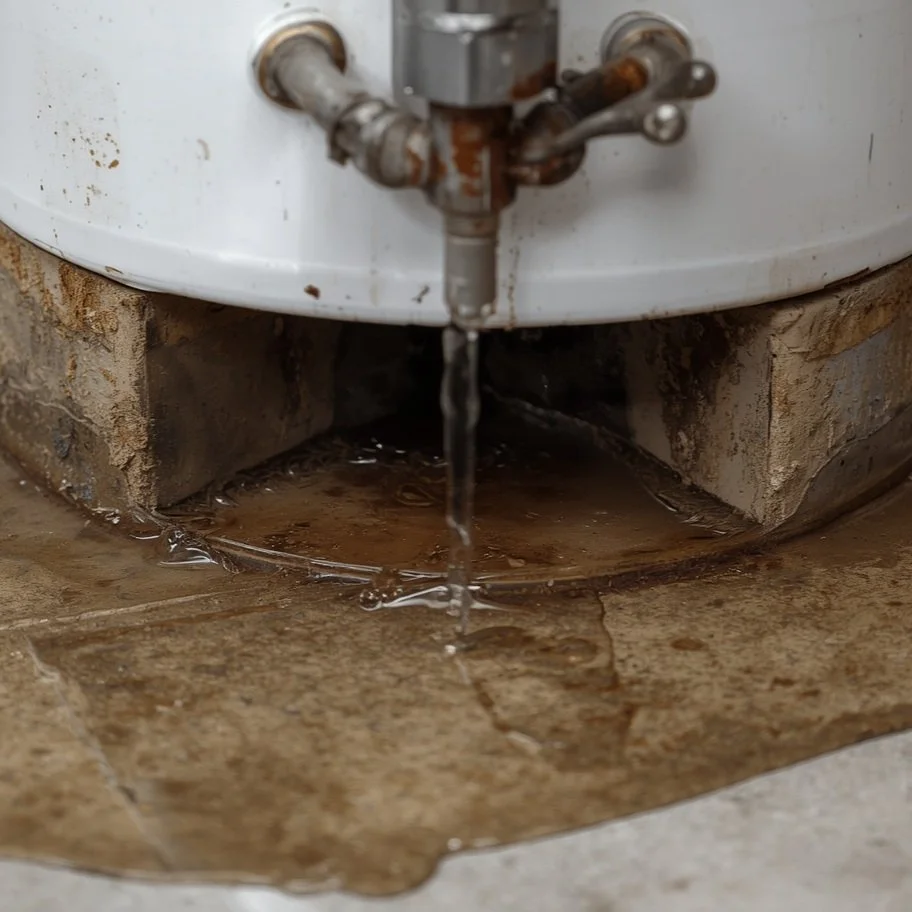
Quick Answer: A water heater leaking from the bottom usually means the steel tank has rusted through from the inside, and a rusted-through tank can't be repaired; it has to be replaced. Before assuming the worst, though, check the parts that can leak and drip down to the base: the drain valve, the temperature-and-pressure relief valve, and the inlet and outlet connections up top. Those are fixable. If water is seeping from the tank itself, the heater is done. Hard-water sediment is what rots most tanks out early.
You go to grab something from the garage, and your sock gets wet. There's a puddle spreading out from under the water heater, and the base of the tank is damp or rusty. First instinct is to find someone to fix it. But where the water is coming from determines whether this is a cheap repair or a new heater, and a leak at the bottom most often means the tank is finished. Before you panic or write a check, it's worth knowing what actually leaks down there and why.
A Bottom Puddle Has Only a Few Possible Sources
Water pools at the lowest point, so a puddle under the heater doesn't mean the leak started at the bottom; it means the water ran down to the bottom. The trick is tracing it up to the source. There are really only a handful of places it can come from, and they split cleanly into two groups: parts you can replace, and the tank itself, which you can't.
Dry the area completely, then watch where the water reappears first. That one observation tells you most of what you need to know.
| Where the water shows up | Likely source | Repair or replace |
|---|---|---|
| Dripping from the drain valve at the base | Loose or worn drain valve | Repair, tighten, or swap the valve |
| Running down from a valve on the side, near the top | Temperature-and-pressure (T&P) relief valve | Repair, replace the valve, or address pressure |
| Wet at the pipe connections on top, trailing down | Loose inlet or outlet fitting | Repair, reseal the connection |
| Seeping from the base of the tank itself, with rust | The tank corroded through from the inside | Replace, the tank can't be fixed |
| Pooling under the tank with no other source found | Interior tank failure | Replace |
The Parts That Can Leak, and Are Worth Checking First
Don't condemn the heater before ruling out the easy stuff. The drain valve is the spigot near the floor used to flush the tank. It can loosen or wear until it weeps, and a drip there runs straight down to make a base puddle that looks like tank failure. Often it just needs tightening or a new valve.
The temperature-and-pressure relief valve is located on the top of the tank. It's a safety device, designed to open and release water if pressure or temperature inside climbs too high. If you find water at that valve, it may be doing its job because the pressure is too high, or it may simply be a worn valve dripping. Either way, it's serviceable, but a T&P valve that keeps releasing is a signal not to ignore, because it means pressure is building somewhere.
The inlet and outlet connections at the top are where cold water enters and hot water exits. A fitting can loosen over time and let water trickle down the side of the tank to the floor. Resealing the connection usually handles it. All three of these are real repairs with real fixes, which is exactly why you check them before assuming the tank is gone.
When It's the Tank, It's Over
Here's the part nobody wants to hear. If you've ruled out the valves and fittings and water is still seeping from the body of the tank, the steel has rusted through and can't be patched. A water heater tank is steel with a thin glass lining baked onto the inside to protect it. A sacrificial anode rod, a metal rod that corrodes instead of the tank, buys the lining years of protection. But the anode eventually dissolves away, and once it's gone, the water goes to work on the steel itself, rusting it from the inside out until a weak spot finally weeps through the wall.
You can't weld it, seal it, or patch it. The rust is everywhere on the inside, not just at the leak, so even if you stopped one spot, another would open. A tank leaking from its own body is at the end of its life. Replacing it is the only real fix.
What rots tanks out early is sediment. In hard-water areas, minerals settle out of the water and pile up on the bottom of the tank. That sediment layer traps heat against the steel floor, creating hot spots that stress the lining and speed up corrosion right where the leak eventually shows. It's the same reason these heaters sometimes rumble or pop: that's water flashing to steam under a crust of sediment. The harder your water, the faster a neglected tank reaches this point.
Flushing the tank once a year clears the sediment that traps heat and rots the steel floor. On a hard-water supply, that one habit does more than anything else to get the full life out of a heater.
What to Do Right Now if It's Leaking
If the puddle is growing, shut off the water supply to the heater at the cold-line valve on top, and kill the power, flip the breaker for an electric unit, or set a gas unit's control to "pilot" or "off." That stops more water from feeding the leak and keeps the heater from trying to heat a draining tank. Then trace the source using the table above. A slow drip from a valve can wait for a scheduled visit. Water seeping from the tank body means start planning a replacement, because a rusted tank can go from a seep to a real flood without much notice.
Frequently Asked Questions
Not always, but often. If the water is coming from the drain valve, the T&P valve, or a loose top fitting, those are repairs. If it's seeping from the tank body itself, the steel has rusted through, and the heater has to be replaced, since a corroded tank can't be patched. Tracing the leak to its actual source is what tells you which situation you're in.
No. The tank is steel with a glass lining, and once it rusts through, the corrosion is throughout the inside, not just at the visible leak. Sealing or welding one spot does nothing about the rest, and another hole opens soon after. A tank leaking from its own body is finished and needs replacement.
The tank relies on a sacrificial anode rod that corrodes in place of the steel. When the anode wears away and isn't replaced, the water attacks the steel itself. Sediment from hard water makes it worse by piling up on the bottom, trapping heat against the tank floor, and accelerating corrosion right where leaks tend to start. Regular flushing and anode checks slow this down.
A small drip from a valve can wait a short while for a scheduled repair. A tank seeping from its body should be dealt with promptly, because a rusted tank can fail further without warning and dump dozens of gallons onto the floor. Shut off the water and power to the unit if the leak is active, and don't let a tank-body leak sit for weeks.
A storage tank heater typically lasts 8 to 12 years, sometimes longer with maintenance, less in hard water that's never flushed. If a leaking heater is already past the decade mark and the leak is from the tank, replacement makes more sense than chasing repairs on a unit near the end anyway. Age plus a tank leak is a clear replace.
It's a good moment to ask the question, since you're replacing the unit anyway. The same-size tank is the simplest swap, but if you've outgrown it, run out of hot water, or want to stop the sediment cycle, a larger tank or a tankless unit may fit better. A plumber can size it to your household and water before you commit.
Trace the Water Before You Spend a Dime
A puddle under the water heater isn't automatically a death sentence, but a leak from the tank body is. Dry the area, watch where the water returns, and follow it back to the source. A valve or a fitting is a fix. The tank itself is a replacement, no exceptions, because rusted steel can't be sealed back together. Hard water and skipped maintenance are what get most tanks there early, so once the new one is in, flushing it keeps it from following the same path.
Found a puddle under the water heater, and not sure if it's the tank? — Get the leak traced and an honest repair-or-replace answer. Plumbing Professionals serves Pasadena, Altadena, South Pasadena, and the surrounding areas. Call (626) 247-3401.
