
Gas Appliance Connector Hissing? Leave First, Then Call
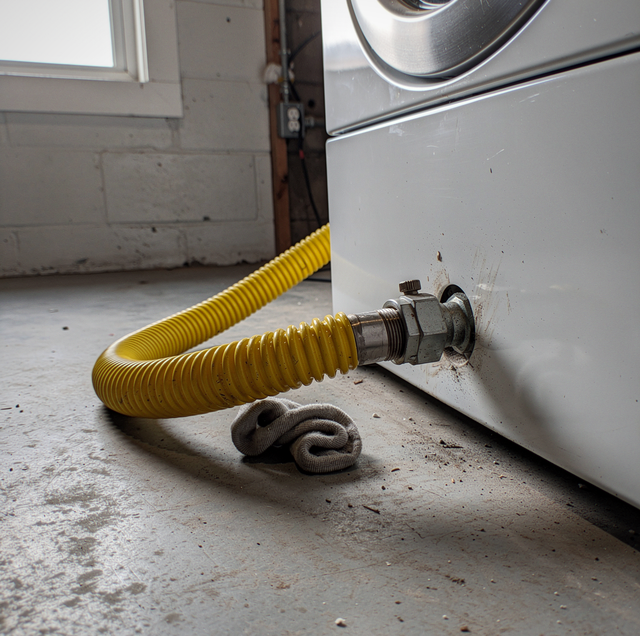
Quick Answer: A hiss at a gas connector is gas escaping right now. Leave the space without touching any switches, appliances, thermostats, or phones; take everyone with you and call the gas utility's emergency line from outside.
You are on your knees behind the dryer with a flashlight, reaching for the sock that went down the back, and a thin, steady hiss is coming from the flexible line at the wall. It is not the dryer running, and it does not stop when you hold your breath to listen. That sound on its own is enough to act on, and the acting comes before the understanding.
Get Out of the Space Before You Do Anything Else
Walk out. Take everyone in the room with you, and the dog, and leave the door open behind you if it opens by hand.
On the way out, touch nothing that switches. Not the light on the wall, not the range hood, not the thermostat in the hallway, not the garage door button, and not your phone while you are still inside. The contacts inside any switch separate with a small arc across the gap, and that arc is an ignition source. This is why the instinct to turn the light off on the way out is backward: the light being on is doing nothing, and the act of turning it off is the dangerous part.
If the appliance's own shutoff valve is on your path out, within arm's reach, and you do not have to walk into the smell or move the appliance or unplug anything to reach it, close it. If any of that is untrue, keep going. A closed valve is worth something. Nobody standing in a room full of gas to reach one is.
Learn your gas shutoffs before you ever need them: a valve is closed when its handle sits across the pipe at a right angle, and open when the handle runs along it. That saves seconds you should not spend in the room.
Call the gas utility's emergency number from outside, from a neighbor's porch or the sidewalk, and tell the dispatcher you can hear it. Audible changes how they schedule you. Call a plumber second: the utility can shut the gas at the meter and make the building safe, and that is the part that cannot wait for a service window.
What an Appliance Connector Actually Is
The connector is the last short piece of the gas system and the only flexible part: a corrugated stainless steel tube, usually under a yellow or black plastic coating, running from a shutoff valve on the rigid pipe to a threaded fitting on the appliance. It exists because appliances move, and rigid pipe cannot absorb that, so the last 24 or 36 inches flexes instead.
Both ends are where the engineering happens. Each end carries a flare: the tube end is formed into a cone, and a nut pulls that cone against a matching seat on the valve or the appliance fitting. Metal seals against metal there, with no gasket and no sealing compound between the two faces. The seal holds because two machined surfaces are pressed together at the right angle and with the right force, and it holds until something disturbs that geometry.
The corrugated middle is the least likely part to fail on its own. It is one continuous piece of stainless steel with no joints, and the household gas pressure downstream of the regulator, at a fraction of a pound per square inch, puts almost no stress on it. Failures cluster at the ends, the only places where separate parts meet and where anyone's hands have ever been.
Why a Hiss Is a Category Above a Smell
Gas leaves an opening because the pressure inside the pipe is higher than in the room. Whether you hear it depends on how fast it moves. Flow has to reach a certain speed through a restriction before it becomes turbulent enough to make noise your ear can pick up. Below that speed, gas still escapes quietly.
Odorant covers the quiet range. Utilities add a sulfur compound to gas so a leak reaches a nose long before the room nears the concentration where gas will burn, which for natural gas is roughly five percent of the air by volume. A smell in a laundry room can mean a very small escape that has had hours to build.
An audible leak sits above the odor threshold rather than beside it. By the time flow is fast enough to hear, it has passed the level a nose would have caught first, which means either a large opening or one that opened suddenly. A hiss is not a more advanced version of a smell you can investigate a little longer, which is why the sequence starts with leaving rather than looking.
The Three Places a Connector Leak Starts
The appliance end comes first because it is what moved. The case a plumber goes looking for is a range pulled out for cleaning or a dryer shifted to reach behind it. Nothing has to be yanked: rotating an appliance a few inches puts a twist into the flare nut, and a flare loaded in torsion rather than straight compression can lift its cone off the seat by a thousandth of an inch. That is a leak, and nothing about it looks bent or broken.
Fatigue in the tube is second. Corrugated stainless takes flexing well within its bend radius and poorly outside it. A connector pushed into a tight loop behind a cabinet, kinked against a wall, or straightened and re-bent through two appliance swaps is work-hardened at the sharp point of that bend, and a crack can start in the wall of a corrugation there. The related version is a connector carried over from a previous appliance: that flare was formed once already, and re-seating it asks a surface that has taken one impression to take a second, different one.
Never put a wrench on a leaking gas fitting. You cannot tell from outside whether the nut backed off or the seat deformed, and torquing a deformed seat cracks the cone, turning a hiss into an open pipe beside you.
The shutoff valve is third, and it is the one nobody expects. A stem runs through the valve body to the handle, sealed by a packing nut. Packing dries and shrinks, especially on a valve that sat in one position for twenty years before being turned during an appliance swap, and gas then escapes around the stem rather than through the connector at all. The valve body and the connector get tested separately for that reason.
Age is the narrower category. Uncoated brass connectors installed in the middle of the last century have a history of cracking and separating at the fitting, and the federal consumer product safety agency has warned about them. Bare brass rather than jacketed stainless is worth replacing on age alone.
What the Service Call Actually Involves
The first move is isolation, not investigation. Gas is shut at the appliance valve, or at the meter if the utility has not already done it, and the space is ventilated before anyone starts looking. Diagnosis on a live leak is not diagnosis. It is standing in the leak.
Once the section is shut and isolated, the connector and the valve are tested rather than eyeballed. A pressure test puts that section under air or an inert gas at a set pressure, with a gauge on it, watched for a set period. A section that holds is sound; one that drops has a leak, and the rate of the drop says something about its size. Only then does a soap solution come out, brushed onto each joint on a section already shut off, showing which fitting bubbles. Soap testing is how a plumber pinpoints a leak that has already been stopped, not a first move on a connector that is hissing, and running it with gas flowing means leaning over a live release with a flashlight.
The repair is a replacement. A connector is not repaired, re-flared, re-taped, or re-seated, for the reason the flare geometry gives: the seal was made once by pressing a formed cone into a matching seat, and a disturbed cone does not reliably reproduce that impression. The instructions packed with a new connector say the same in plainer words: that it is installed once and not reused. The replacement is sized for the appliance's demand and run length, made up with sealant on the pipe threads and nothing on the flare faces, then pressure tested.
Restoring service is the last step, and it belongs to the utility or the plumber rather than the household: every appliance on the line has been sitting with its pilot or igniter cold, and each gets checked and lit by them. Whether a replacement requires an inspection or a permit varies by jurisdiction, and the local building authority determines that.
An Odor Call and an Audible One Are Not the Same Call
Both get taken seriously, and they are not the same visit. A smell with no sound points to a smaller escape, and it may be intermittent: a valve packing weeping, a joint that seeps only once the appliance fires and the pipe warms, or something with no connection to the connector at all. The work is mostly detection, isolating sections and pressure testing them one at a time, working outward from the meter. There is a real chance a technician finds nothing on the first pass, a property of small leaks rather than a failed visit.
A hiss removes the search. The location has announced itself; the rate is already above what a nose can catch; and the job becomes containment followed by replacement. The time goes into confirming the connector was the only thing that failed, since whatever moved the appliance far enough to open a flare may also have strained the valve behind it.
Neither one resembles water-side trouble, which is a separate investigation with separate tools.
Frequently Asked Questions
The meter's main valve is not hand-operable: it takes a wrench on a rectangular tang, turned a quarter turn so the tang sits across the pipe. If you do close it, leave it closed and say so to the responder, because restoring gas is their step.
Opening a window or door by hand costs nothing and helps. Switching on a fan does not: a bathroom fan, a range hood, or a whole-house fan puts a switch and a motor directly in the path of the gas and pulls the gas across both. If no window is on your way out, leaving still beats venting.
No. A carbon monoxide alarm senses a product of incomplete combustion, so it responds to an appliance burning badly, not to raw fuel escaping from a fitting. A silent CO alarm says nothing about gas in the room; raw gas needs a combustible gas alarm, a separate device with a different sensor.
Air movement. Natural gas is lighter than air, so it rises and disperses through a ceiling, an attic hatch, or an open upper window, and a room that smelled strongly can smell like nothing twenty minutes later, with the leak still running at the same rate. Propane does the opposite, settling into basements and floor cavities and sitting there. A fading smell is not evidence a leak stopped.
No. Yellow-jacketed tubing routed through the framing serves as the whole-house distribution system, joined with its own fittings and bonded to the home's electrical grounding. A connector is a terminal assembly sold in fixed stock lengths, commonly 12 to 48 inches, that stays in the open behind the appliance. Two are never joined to reach farther, and one does not pass through a wall, floor, or cabinet partition.
The meter is the dividing line. The service line feeding the house and the meter itself belong to the gas utility, which is why they can shut and lock it. Everything downstream, the house piping, the shutoff valves and the connectors, is the owner's side and a plumber's work. A responder makes the property safe and may tag an appliance out of service; the house-side repair is a separate visit.
Hissing gas connector or a gas smell you cannot place — call the gas utility first, then have the connection tested and replaced. Plumbing Professionals serves Pasadena, Altadena, South Pasadena, and surrounding areas. Call (626) 247-3401.
