
Sink Shutoff Valve Won't Turn Off? What's Seizing It
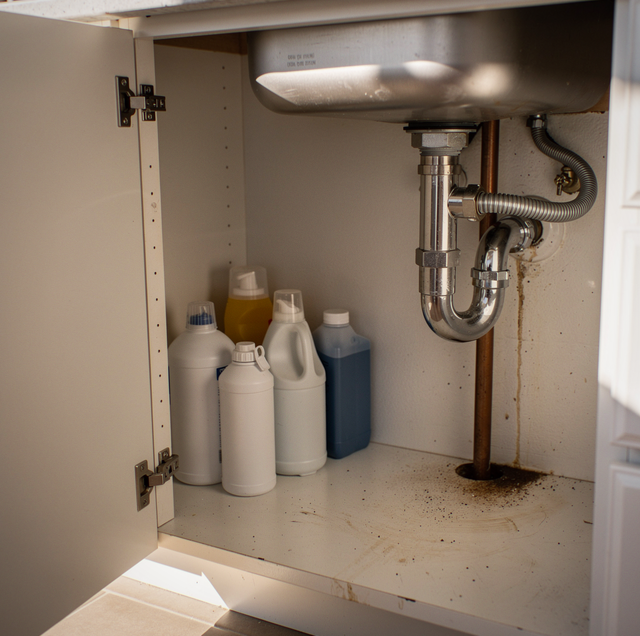
The small valve on the wall under your sink is there so one faucet can be isolated without shutting off the water to your whole house. Most sit untouched for a decade or more. Then a faucet starts dripping, you open the cabinet door, and the handle either spins freely against no resistance or refuses to move at all.
Water keeps moving through the supply line either way, and the small repair you came to make has become the larger one. A stop that will not close has a short list of causes, and they are separable: a plumber can tell them apart in about the time it takes you to clear the cabinet. Which one you have under your sink changes what the fix actually is.
Inside the Stop Valve Under Your Sink
Two designs sit behind almost every fixture supply in your house, and they close differently. The older one is a compression valve, also called a multi-turn valve, and it is usually built as a globe valve. It has a stem with a rubber washer at the end, attached to the valve handle, and turning the handle moves the stem into the valve cavity, compressing the washer against the internal seat to form a seal.
The newer design closes on a different principle. Quarter-turn valves are a more recent addition and use a ball-valve design: a 90-degree turn orients the hollowed-out ball inside to either block the water's path or allow full flow through the unit. One squeezes a soft washer onto a seat across several turns; the other rotates a drilled ball through a quarter circle. Which motion has stalled is your question.
Multi-Turn and Quarter-Turn Stops Fail Differently
Neither design is immune, and both carry the same reputation for seizing: either the stem or handle locks up and stops moving, or the stem simply breaks off. A seized multi-turn stem can sometimes be worked free; a seized quarter-turn cannot. That reputation may be an exaggeration as easily as it may be a regular occurrence, and either way it is worth planning around.
Both halves of that matter to you, because they describe two different dead ends. A leaking quarter-turn stop has no repair path at all: once yours begins to weep, it has to be replaced. Build quality carries more weight than any brand label on the packaging, and the detail worth checking is the internals: the ball inside should be metal, not plastic.
Mineral Scale and the Stem That Stopped Moving
Hard water turns a working multi-turn stop into a single piece of brass, even though nothing is being asked of it. Every part of the stem lives in water: the threads it rides on, the shoulder that carries its packing, and the washer pressed against the seat below. Calcium and magnesium drop out of solution wherever flow is slow or still, and inside a stop held wide open for fifteen years, that water barely moves. Deposits build in the thread clearance and across the seat face, and the washer hardens against them until the two behave as one part. The handle under your sink is not stiff because the packing is overtightened; it is stiff because the moving pieces have grown together.
That is why the first turn is the hardest one, and why a stop that has not moved since the house was plumbed can feel welded solid on the very first attempt.
Stop turning the handle the moment it stiffens and close the main house shutoff instead, because a sheared stem leaves you with no way to stop the water.
A plumber meeting that stop will not fight it. Your supply gets isolated upstream, the old stop comes off, and a new one goes on to suit the fixture. Forcing the handle before you get there changes which parts you replace and how long you spend down there.
When the Handle Spins and Nothing Closes
A handle that turns without ever meeting resistance has already failed, usually in one of two places. The stem may have sheared below the packing, leaving the handle attached to a stub that no longer drives the washer onto its seat. Or the broach at the top of the stem has rounded off, so the handle spins on a stem that never moves.
Either way, the water is still on, and the fixture cannot be worked on. The main house shutoff becomes the working valve for the rest of the job, which is why knowing where yours sits matters more than any repair described. A second person stationed at the main makes the job go faster still.
Does a Seized Stop Always Need a Full Replacement?
Not always, and the split runs along valve type and condition. On a multi-turn stop under your sink, the wear parts really are serviceable: the compression washer can be renewed once water has degraded it, and so can the packing that keeps water from creeping up around the stem. A stop that closes fully but weeps a little at the stem under pressure is a different finding from one that will not close at all, and it earns a different scope of work.
Servicing stops being worth pursuing when the whole valve is simply old. Renewing one part leaves every other worn part in place, which is how you get a valve serviced twice in one season, and parts for older stops can be hard to track down at all. A quarter-turn stop removes the choice entirely: its ball, seats and stem come as one sealed assembly, so a quarter-turn that leaks gets replaced rather than repaired.
What a plumber weighs at the cabinet is the state of the valve in front of them and the fixture it serves. A dishwasher or an ice maker line asks something different of a stop than a lavatory faucet does, and the replacement is picked to suit that fixture's requirements rather than whatever happened to come out. The pipe behind the stop counts too, since brittle galvanized changes everything. Our own summary of this work names the finish line: "Tested-tight installs with proper shutoffs every time."
Weeping at the Stem Against a Stop That Will Not Close
These two get confused because both look like valves that have gone wrong. A stop that seeps a bead of water around its stem as the handle turns is failing at the packing, and it may still shut off your supply completely.
A stop that travels its full range while water keeps running past it has failed at the seat instead, and its packing may be perfectly dry. One symptom sits above the seal, and the other sits right at it, so the repair your plumber picks is not the same.
Testing a Stop Outside of an Emergency
The upkeep advice here is about prevention rather than repair: leave the valves fully open, avoid over-tightening them, and test them once in a while so they can be replaced before an emergency. A stop you exercise in March is a ten-minute errand, and the same stop found at eleven at night is a different evening entirely. The difference between those two versions of one task is timing and nothing else.
Dishwasher line service already covers this ground: new supply lines are installed, shutoff valves are inspected, and wastewater is checked to ensure it drains freely without backing up. A stop gets looked at during work booked for something else, which is the calmest moment anyone will find a bad one. The valve you will need in five years is the one worth turning this month.
Frequently Asked Questions
They share a name. A compression valve should not be confused with the compression fitting connection type, where a nut and sleeve are used to create a seal. One is the valve body you turn; the other is how your stop joins your copper. Mixing them up buys you the wrong part.
Rarely, and never on the stop that failed. Isolating a bad one means closing something upstream, which in most homes is your main house valve or the meter. Some properties have a branch valve serving one bathroom, and where you have one, the rest of your house keeps running while you work.
It can, and the mechanism is worth knowing before you blame the installation. Water hammer is the design's real trade-off, since a quarter-turn can be shut so fast that moving water slams to a halt against a closed ball. A multi-turn cannot close fast enough to do that. Closing your new stop over two or three seconds quiets it, and a bang you cannot quiet points at arrestors or air chambers in your walls.
Use is the variable. A toilet stop turns when a fill valve is swapped, and a laundry stop closes for hose changes. The lavatory stop under your sink that nobody has touched since it was built is the one you find welded shut, on water identical to the rest of yours.
The internals are the same; the body is not. An angle stop turns your supply ninety degrees, which suits a pipe coming out of your wall, while a straight stop carries it in line for a supply rising through the floor. Getting that orientation wrong is the usual reason a replacement will not reach your faucet, so the shape gets confirmed before the old one comes off.
Weak flow is a different complaint from a stop that will not close, and our own fixture and appliance page treats it as its own diagnosis: "Noticeably weaker flow at sinks or appliances can signal mineral buildup inside supply lines or partially closed shutoff valves. Water pressure supports effective cleaning, rinsing, and appliance operation. Restoring balanced pressure improves performance and reduces frustration during everyday use." So a stop that turns easily but never fully opens is worth checking before you go hunting for a clogged aerator or a tired cartridge, and checking yours takes you less time than pulling your faucet apart.
A stop that will not close under your sink is worth replacing before the next repair depends on it — our team replaces fixture shutoff valves, tests the connections tight, and checks the supply lines feeding each fixture while the water is still under control. Plumbing Professionals serves Pasadena, Altadena, South Pasadena, and surrounding areas. Call (626) 247-3401.
