
Water Heater Relief Valve Discharging? Look Past the Valve
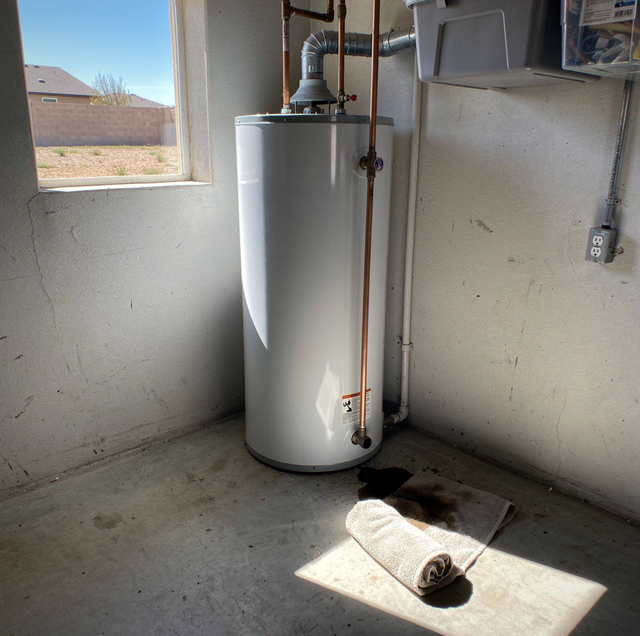
You have been mopping the same patch of floor beside the water heater for two weeks. The copper tube running down the side of the tank has been letting go a few ounces at a time, and it started before you noticed, because the first of it dried off the slab between one laundry day and the next. Now the puddle comes back faster than it evaporates.
That tube is the discharge line for the temperature- and pressure-relief valve. The valve sits at the top of the tank, and it does one thing: open. It has been opening. Water inside has been reaching a number that trips it, again and again, and every drop on your floor is the valve doing its job.
The Valve Has Two Independent Set Points
The temperature and pressure relief valve threads into the top of the tank or the hot outlet line, and carries two triggers in one body. One responds to pressure in the tank. The other responds to the temperature of the water its probe is sitting in. Either one alone opens the valve, and it reseals on its own once the condition clears.
The temperature side is the one people find odd, because a water heater is supposed to make hot water. The setting sits just under the point where water boils at atmospheric pressure. A boiling point is a pressure statement, not a temperature one. Water held above that stays liquid only while the tank's pressure holds it there, and if the vessel ever opened, that water would flash to steam and expand into the room. The valve moves before the tank can hold water in that state.
Manufacturer engineering specifications for residential T&P valves state plainly that the device serves emergency relief and is not to be used as an operating control. That is the sentence to hold while you work out why yours is running. A valve that opens has been given a reason. Your job over the next few minutes is to find out which reason it was.
Thermal Expansion in a Closed System
Water takes up more room hot than cold. Going from a 60-degree supply to a 140-degree setting, its volume rises about 2 percent, a figure a steam table gives directly: liquid water runs 0.016035 cubic feet per pound at 60 degrees and 0.016358 at 140 degrees. In a 50-gallon tank, that is roughly one extra gallon produced each time the burner or element completes a cycle.
In an older house with nothing one way on your service line, that gallon pushes back out toward the street. Put a backflow preventer, a check valve, or a pressure-reducing valve on the line and the door closes behind it. Now the extra volume has only the compressibility of water to work against, and water barely compresses, so pressure in your pipes climbs steeply for a small change in volume.
It climbs until it reaches the valve's pressure setting. The valve opens, passes a few ounces, and reseals. Then your next heating cycle does it again. Manufacturer guidance on the subject tells a homeowner whose 24-hour gauge reading runs over 80 psi to have the pressure brought down to 50 or 60. An expansion tank on the cold line takes that gallon and keeps the rise under the valve's setting.
What Separates an Expansion Drip From an Overtemperature Discharge?
Start with when it happens. Timing separates the expansion case from the overtemperature one before you touch anything. Expansion discharge is tied to the heating cycle. Your heater fires, or the element comes on, the tank pressure rises, and a few ounces leave the tube near the end of the cycle. Open a hot tap while it is dripping, and the drip stops, because you have just given the expanded water somewhere to go.
Overtemperature does not look like that. The discharge comes as a run; it does not stop when you open a tap, and the water is hot enough to steam. On an electric heater, the line is harder: several gallons on the floor around the discharge pipe is not thermal expansion, so kill the heater's breaker or pull its fuses and have the thermostats and elements checked.
A stuck thermostat can drive the tank past the temperature setting stamped on the valve, near 210°F. Water leaving the discharge tube arrives at that temperature and will scald. Stay clear of the outlet until the heater is off.
A third pattern ignores the timing altogether. A valve that drips at a steady rate whether or not the heater has run, and keeps dripping with a tap open, is leaking past its seat. Mineral deposits can adhere to the valve and render it inoperative, and a seat that has been weeping for months has been building them on the surface that has to seal.
The First Minutes, and the One Thing Never to Do
Never cap the valve or plug its discharge tube, and never fit a shutoff anywhere downstream of the outlet. A relief valve with its outlet blocked leaves the tank with no relief path at all, and the failure it is designed to prevent is rupture.
Do this instead. Cut the heat input first: on a gas heater, turn the control knob to its pilot or off position, and on an electric one, switch off the breaker at the panel. That stops the tank taking on energy while you work out the cause, and it takes the overtemperature branch off the table within the hour. Leave the water supply on unless the flow is fast enough to do damage.
Then leave the discharge tube where you can see it. The maker's installation instructions have the line running downward and ending where any discharge is clearly visible, which is the opposite of a bucket you empty and forget. A tube routed into a hidden pan buries the one symptom a plumber would want to see.
If the tube is dry and the water is standing under the tank itself, you are looking at a corroded tank and a repair that requires a different approach.
The Numbers Stamped on the Valve Body
Every T&P valve carries its ratings on the body or on a metal tag at the test lever, readable from the floor with a flashlight. A common valve series lists a temperature relief setting of 210 degrees Fahrenheit and standard pressure settings of 75, 100, 125, and 150 psi. On that series, it is one of those four; the figure that applies to you is the one printed on your own valve.
The figure beside them is relieving capacity, stamped in BTU per hour. On that same series, it runs 15,000 for the half-inch body and 105,000 for the three-quarter-inch body. Your heater's input sits on its own rating plate, printed in BTU per hour on a gas heater. An electric one prints watts, and a watt is 3.412 BTU per hour, so a 4,500-watt element works out near 15,400.
Whether an inspector looks at that pairing where you live is a question for your local building authority. The arithmetic runs the same either way, because a valve that cannot pass heat as fast as the element or burner adds it cannot hold the tank at its set point. The device must have the required safety certification, and its BTU output must exceed the heater's BTU input rating. On that three-quarter-inch body, the capacity is the 105,000 stamped on it, and the number it has to clear is on the plate a few feet below it.
Frequently Asked Questions
Any water leaving that valve means expanded water had nowhere else to go, so treat a few ounces after a heating cycle as that condition. The same pressure reaches your fixtures. Manufacturer guidance on thermal expansion describes a faucet that surges the instant you open it, and one that drips on its own after more than thirty minutes with nothing drawn. Either puts the condition across your whole house, not just the heater.
A backflow preventer or check valve at the meter, or a pressure reducing valve where the supply enters the house. Any of them passes water one way. You may not have to identify which. An expansion tank, where one was fitted, goes on the cold supply line between the heater and that one-way device, so a small tank on that run means someone already treated your system as closed.
A wrench takes it out, but a valve replaced before the cause is dealt with drips again. Probe length is the detail to check next. The temperature-sensing element needs to be immersed in water within the top six inches of the tank, which is why it is sold with both short and extended probes. Buy on thread size alone, and you get a probe sitting in the tapping, and a temperature trigger that never reaches the temperature.
Less expansion per cycle, because a smaller temperature rise produces a smaller volume increase. Manufacturer sizing guidance for residential expansion tanks is published in separate tables for maximum settings of 140, 160, and 180 degrees, and the tank called for increases as the setting rises. That is the same volume your relief valve is otherwise passing onto the floor. Turning it down shrinks that volume without opening a closed system.
The manufacturer's instructions state that the lever be operated once a year to confirm the waterway is clear, and that the valve be reinspected every three years by a licensed plumbing contractor. Lifting the lever discharges hot water, so it is done with the discharge line connected to a safe point. If no water flows when you lift it, the direction is to shut the heater off and call a plumber: the valve is inoperative.
A thermal expansion tank holds an air charge behind a bladder, set at installation to match your cold water supply pressure. Follow the manufacturer's instructions: adjust it with the tank empty, and check it only with the tank isolated, since checking bleeds out a little air each time. A torn bladder or an escaped charge leaves a plain steel vessel taking no volume. Weight is the tell: it gains roughly eight pounds for every gallon it has taken on.
Because a new valve on an unchanged system does exactly what the old one did, the two jobs run in a fixed order — the expansion side first, the valve after it. Plumbing Professionals serves Pasadena, Altadena, South Pasadena, and surrounding areas. Call (626) 247-3401.
