
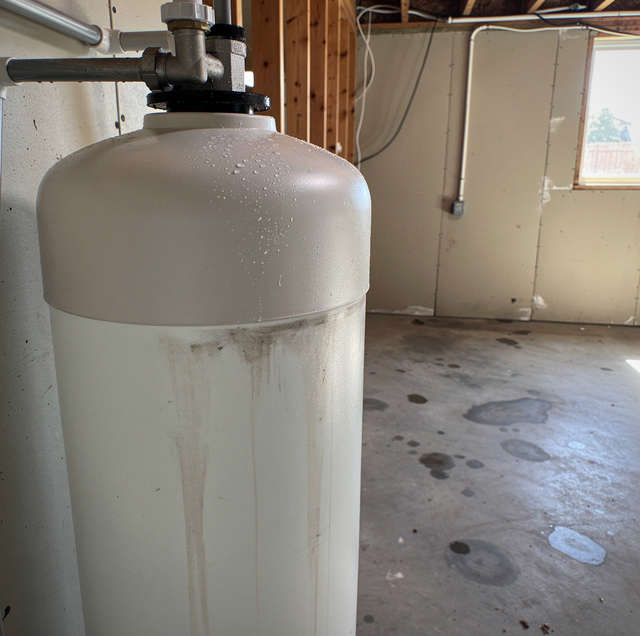
A water softener uses salt in direct proportion to how frequently and how heavily its resin bed regenerates. Regeneration is the maintenance cycle that restores the resin's capacity to exchange calcium and magnesium ions, and each run draws a fixed amount of brine from the tank. When a bag of salt empties in a fraction of the time it used to, the salt itself is not the problem; something upstream is pushing the unit into more regeneration cycles, heavier ones, or cycles it should not need to run at all.
How Regeneration Uses Salt
Inside the resin tank, small resin beads carry a negative charge that attracts positively charged mineral ions. As hard water passes through, calcium and magnesium ions stick to the beads, and sodium ions already on the resin are released into the water instead, which is the softening step itself. Every bead has a finite number of open sites, and once enough of them are filled with hardness minerals, the resin stops softening effectively until it is recharged.
Recharging is what regeneration does. The control valve draws concentrated brine from the tank through the resin bed, and the high concentration of sodium ions in that brine forces calcium and magnesium ions off the beads, replacing them with sodium. A rinse cycle then flushes the displaced minerals and the leftover brine to the drain, and the brine tank refills with water to dissolve more salt for the next cycle. The amount of brine pulled per cycle is set at installation, so salt use depends on how many times the cycle runs and how much water refills the brine tank each time. Two designs decide that count. A timer-based valve regenerates on a fixed schedule, regardless of how much water has passed through during that stretch. A meter-initiated valve tracks gallons used and triggers a cycle once a programmed volume has gone through the resin, so its salt use follows real water use rather than the calendar.
Matching a Salt-Use Pattern to Its Cause
Each of these causes leaves its own signal before the tank is even opened:
| What's happening | The clue to look for |
|---|---|
| The regeneration timer runs on a fixed schedule that doesn't track water use | Salt drops on a predictable calendar rhythm no matter how light or heavy that week's water use was |
| The hardness number programmed into the control valve reads higher than the water tests | The unit regenerates after fewer gallons than the household's use would call for. |
| A fixture on the softened side is leaking | The household's overall water use keeps climbing on days no one recalls running extra water |
| The brine valve or float is stuck | Water stands above the fill line in the brine tank between cycles, and the salt above it sits wet or slushy |
| The resin bed has aged past its working capacity | Water tests hard before the next scheduled cycle, and raising the settings has not held it. |
Settings That Drive Salt Use
A timer-based valve is programmed once, at installation, for a schedule that fits the household's expected water use at that time. If that schedule was set for a heavier-than-average week, or if water use in the home has dropped since (kids moved out, a fixture was replaced with a low-flow model), the valve keeps running the same schedule anyway, because it has no way to know the water use changed. Brine gets drawn on days the resin never came close to needing it.
The hardness setting works differently but causes the same waste. At installation, a number representing the incoming water's hardness gets entered into the control valve, and on a meter-initiated valve, that number sets how many gallons the resin can treat before it regenerates. If that number was entered higher than the water tests, the valve treats the resin as closer to full than it is and calls for a cycle before the beads are anywhere near capacity. Reprogramming either the schedule or the hardness number is a control-head adjustment, not a resin or tank replacement, and it is the first setting checked once a leak and a mechanical fault have been ruled out.
Water Use the Softener Counts That You Don't See
A meter-initiated softener counts every gallon that passes through the resin tank, not just the water someone consciously ran at a faucet or in a shower. A toilet flapper that lets the tank refill slowly all day, a dripping outdoor bib plumbed to the softened side, or a slow leak under a sink adds to that count around the clock, whether anyone is home or not. Because the valve cannot distinguish water that was used from water that was wasted, that hidden volume shows up as extra regeneration cycles and on the water bill.
A control valve's display can show a running total of gallons treated since the last cycle. Comparing that number against the household's normal water use for the same stretch can flag a hidden leak before the salt level does.
Mechanical Faults That Waste Brine
A brine valve or float that no longer shuts off on time lets extra water into the tank, and every extra gallon dissolves more salt, so each cycle draws more than the setting calls for.
Diagnosing a stuck float or valve means opening the brine tank, and that starts with putting the unit on bypass and unplugging the control head before anything inside the tank is touched, since brine and the tank's internal fittings are not something to work with while the system is live. The valve head itself is a sealed assembly built around small springs, seals, and a piston or disc mechanism, and it is not a take-apart-and-see job; the wrong tool in the wrong spot can crack a seat or cause a part to be lost that has no visible substitute.
Forcing a bar or broom handle through a salt bridge can crack the brine tank wall or snap the float, flooding the floor with brine. With the unit unplugged and bypassed, a technician breaks the crust with light taps from above.
When the Resin Bed Itself Is the Question
Resin beads do not last as long as the tank they are in. Years of regeneration cycles, exposure to iron or sediment in the source water, and simple chemical wear gradually reduce the number of mineral ions each bead can hold before it needs recharging. Once that capacity drops, a timer or meter valve keeps regenerating on the same schedule it was given, so the resin runs out before the next cycle and hard water breaks through between cycles. Salt use climbs when the schedule or hardness number gets raised to chase that hardness, which spends more brine on beads that can no longer hold it.
Adding extra salt to the tank does not restore lost capacity, since the resin bed's ability to hold ions, not the salt supply, is what limits softening at that point. A water test that comes back hard shortly after a completed regeneration cycle, even with a full brine tank and a correctly set timer and hardness number, leaves two suspects: the resin bed, or water slipping past it through a partly open bypass or a failed internal riser.
Frequently Asked Questions
Not the amount each cycle draws. Rock salt carries insoluble minerals that do not dissolve and settle as sludge at the bottom of the brine tank, while pellet and crystal salt are refined to leave little of that behind.
No. A tank that runs dry keeps regenerating on schedule, only with plain water instead of brine, so the resin gets rinsed without being recharged. The result is hard water reaching the house until salt is added back, not damage to the beads themselves.
No. The brine draw per cycle is set by the refill, not by how much salt sits above it. Overfilling the tank traps humidity against the salt above the waterline instead of letting it dissolve evenly, and that trapped moisture is one way a hardened crust forms across the top of the salt.
Not on its own. A household with an unusually large number of people can regenerate close to daily on a correctly set unit. The way to tell a legitimate high-volume household from a fault is comparing the unit's logged cycle count for a week against a rough estimate of the household's water use for that same week.
Yes. A private well drawing from a different depth as groundwater levels shift, or a change somewhere upstream of the meter, can alter incoming hardness after a softener's settings were first programmed. When that happens, the original hardness number entered into the valve no longer matches the water now arriving, and the mismatch reads like a setting problem until the water itself is retested.
Yes. Bypass routes all incoming water around the resin tank, so untreated hard water reaches every fixture in the home as soon as the softened water already in the pipes is drawn off, not just fixtures near the softener. Returning the valve to its normal service position restores softened water to the whole house just as quickly, once any work inside the tank is finished.
Bring in hard water treatment service — the regeneration schedule, hardness setting, brine valve and float, and resin bed are checked against the salt the unit uses. Plumbing Professionals serves Pasadena, Altadena, South Pasadena, and surrounding areas. Call (626) 247-3401.