
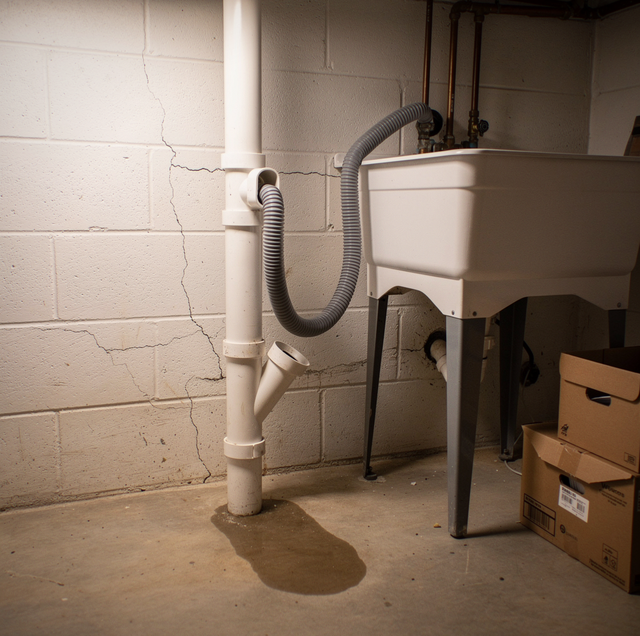
A standpipe is the open vertical pipe a washing machine's drain hose hooks into rather than connects to directly. It leads down to a trap and then into a branch drain, and between loads it holds nothing but the air the hose sits in. When the washer's pump starts, the standpipe carries the whole load at once, rather than the steadier flow a sink sends down. The pump moves a large volume of water in a short burst, and everything below the standpipe, the trap, the branch, and the line it ties into, has to carry that burst away about as fast as it arrives. Anything that slows that path, even a little, can show up first at the standpipe, since it is the only open point in the system where rising water has nowhere to go but back out over the rim.
The pattern the overflow follows narrows down where along that path the trouble sits, before anyone opens a wall or pulls the machine out.
| What you notice | Where the trouble likely sits |
|---|---|
| Overflow at the first pump-out of every load | The hose, the standpipe connection, or a trap that is fully blocked |
| Overflow only on large or heavy loads | The trap or branch, narrowed but not yet blocked |
| Gurgling at a nearby sink or tub while the washer drains | A shared branch losing air instead of venting properly |
| Water rising in a floor drain or another fixture at the same time | The branch or the line downstream of the standpipe |
| Overflow that began after the washer was moved | Something changed at the hose during the move |
| A laundry sink on the same line drains slowly too | The branch itself, not the washer alone |
Pump Output Against What the Drain Can Carry
A washing machine doesn't drain the way a sink or tub does. A sink drains by gravity once the stopper is pulled, with the flow spreading over however long the basin takes to clear. A washer's pump switches on at full output and pushes the tub's water out in one continuous pump-out, all of it arriving at the standpipe at once rather than trickling in. A healthy standpipe, trap, and branch absorb that burst with room to spare: water rises for a moment while the pump runs, then drops back once the pump stops.
Where the drain path can no longer carry that full burst, the standpipe becomes the overflow point. Water backs up inside the pipe under the pump's push, and because the standpipe is open at the top with nothing between it and the room, that backed-up water has one place left to go: over the rim and onto the floor. A restriction that would only slow a sink's flow becomes an overflow the moment a burst washer meets it, which is why a standpipe can be the first sign of a drain that has been narrowing for a while.
Lint, Soap and Debris Narrowing the Trap and Branch
A laundry drain carries lint and fabric fibers that other branches in the house do not, along with dissolved soap or detergent in every wash cycle's water. Fibers catch on the rough inside of the trap and branch, soap residue hardens against that catch, and the buildup thickens with every load until the working opening left inside the pipe is a fraction of what it started as.
None of this shows itself gradually at the standpipe. A branch narrowed by fiber and soap buildup can still pass a small load without any sign of trouble, because a small load's burst still fits through the opening left. The same branch fails the moment a heavier load's larger burst meets it, which is why an overflow can seem to start out of nowhere on wash day rather than building up a little at a time. Clearing that buildup out of the trap and branch is drain cleaning, work aimed at the pipe rather than the washer. Chemical drain openers do not belong in a line holding standing water, and water that has backed up from a drain is wastewater, cleaned up with gloves on.
The Drain Hose Set Too Deep or Sealed Too Tight
Checking the hose starts with the washer stopped and unplugged, before it is pulled from the wall. The hose itself is worth ruling out before anything below it. A washer's drain hose is meant to hook loosely into the top of the standpipe, leaving open space around it so air can move freely alongside the water. Push that hose too far down the pipe, or seal it tight enough that no air gap remains, and nothing but open air separates the washer's tub from the drain.
A hose pushed deep into the standpipe can end below the level water rises to during a pump-out, and with no air gap around it the washer's tub and the drain become one connected column: water can siphon out of the tub between fills, and dirty water in the standpipe can be drawn back into the machine. A hose sealed airtight into the pipe does the same, and it can also pull the water out of the trap below, leaving the drain open to sewer gas. Either fault is likeliest on a hose that was recently disturbed or replaced.
Standing water near a plugged-in washer or a wall receptacle carries a shock hazard. The circuit gets shut off at the panel before anyone reaches behind the machine or into standing water, a step the plumber takes first.
Venting and the Main Line
Air has to move through the branch alongside the water, or the water can't drop through the trap as fast as the pump sends it; the local code and inspector decide how a laundry branch is vented. If other drains besides the laundry line back up around the same time, or the same overflow keeps returning no matter what changes at the washer or the hose, the restriction has likely moved past the branch and into the main line itself.
Clearing the Laundry Drain Path from Hose to Branch
Work on a standpipe overflow starts at the hose and follows the same path as the water. The hose gets pulled and reset with a proper air gap if it was sealed or seated wrong; the trap and standpipe get checked for the fibrous buildup that laundry lines collect, and a camera goes down the branch when the overflow pattern leads past the trap or the backups keep returning after clearing. Where the branch is coated in lint and hardened soap rather than plugged by a single mass, the fix can be high-pressure cleaning suited to the pipe rather than a cable, since a cable opens a path through the buildup and leaves the pipe walls coated. The standpipe height and trap arrangement fall under the local plumbing code, and where an improvised installation doesn't meet it, that gets flagged and corrected.
Frequently Asked Questions
It can be the machine's side. A replacement washer can carry a stronger drain pump than the one before it, and a drain that kept up with the old pump can overflow under the new one's pump-out with nothing changed in the pipe. Running the washer alone, with no other fixture draining, rules out a shared-branch cause first.
Yes. A rubber discharge hose that has stiffened or cracked at the bend where it hooks over the standpipe lip can cause water to spray sideways during the pump-out instead of dropping straight down into the pipe, making it look like the standpipe itself is overflowing even when the pipe below it is running clear. A hose showing cracking or a lost bend at that point is worth replacing before any other cause gets chased.
One reason: a branch that is narrowed but not blocked can clear one load's burst with room to spare and still be carrying some of that load's water when the next cycle's pump-out arrives close behind it. The second burst meets a pipe that has not fully emptied from the first, leaving less room to absorb it, so the overflow can show up on the load with the least time to recover rather than on the first one of the day.
It can help catch fibers before they reach the trap, but a bag or screen left in place too long becomes its own restriction, slowing the burst it was meant to protect the pipe from. A catch of this kind only helps if it gets emptied or replaced on a schedule that keeps it looser than the pipe it sits ahead of.
It changes what a smell means more than what an overflow means. A floor drain dry from disuse has lost its trap seal, so a pump-out surging through a shared branch can push sewer gas out of it, and a sewer smell in the laundry area while the washer drains can come from that dry trap rather than from the standpipe.
Water in the trap below the standpipe is normal, since that water seal blocks sewer gas. Water still standing in the standpipe after the pump has stopped means the branch is draining more slowly than it should, even on a load that did not overflow.
Enlist drain cleaning for your laundry drain line — including trap and branch cleaning, plus a camera inspection — if the line keeps backing up. Plumbing Professionals serves Pasadena, Altadena, South Pasadena, and surrounding areas. Call (626) 247-3401.