
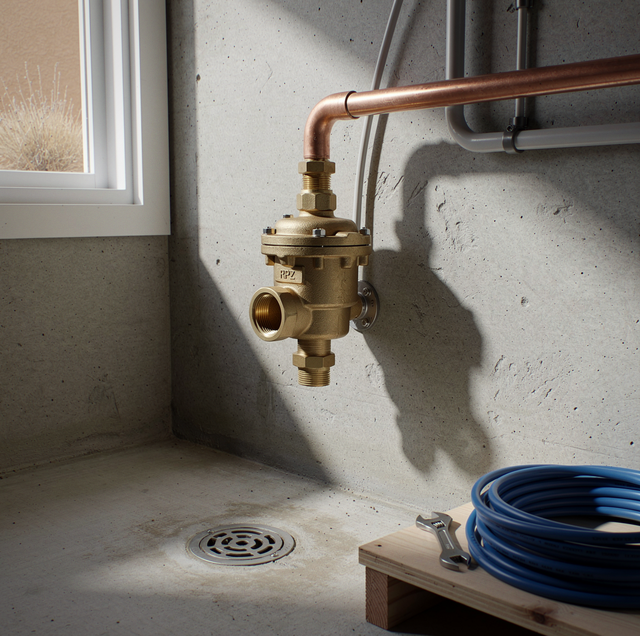
Which backflow assembly a building needs depends on what water on the building side could carry back toward the public supply, and the water provider or local authority sets that requirement for each connection. A double check valve assembly mitigates low-hazard conditions with two spring-loaded check valves in series, so water can move only toward the building. A reduced pressure zone assembly (RPZ) pairs two checks with a relief valve that opens to the air when protection starts to slip. That relief valve is what connects the RPZ to a high-hazard system, and it also determines where the device can be installed and what trouble looks like from the outside.
Set side by side, the two assemblies differ in how they stop reverse flow, the hazard they suit, whether they discharge, where they can go, how a tester checks them, and how a fault shows.
| Double check valve assembly | RPZ (reduced pressure zone assembly) | |
|---|---|---|
| How it stops backflow | Two independent spring-loaded checks in series; either one closing blocks reverse flow | Two independent checks plus a relief valve in the space between them that vents to open air |
| Hazard level it's matched to | Low hazard: substances that could spoil taste, odor, or color without threatening health | High hazard: substances that could make someone sick, such as chemicals or sewage |
| Relief/discharge behavior | None; the assembly holds all water inside its body | Relief valve releases water from the middle zone when zone pressure closes in on supply pressure |
| Installation needs | Room to reach it for testing; a below-grade vault can be acceptable where the water provider allows it | Above grade, open air under the relief port and a planned route for discharged water |
| Testing | Tested in place through built-in test cocks | Same, plus the relief-valve opening point |
| What failure looks like | Nothing visible; a leaking check valve surfaces only during a test | Water leaving the relief port: the device protecting the supply while it signals that something upstream or downstream needs attention |
Back-Siphonage and Back-Pressure: Two Ways Water Runs Backward
Backflow is any movement of water from a building's piping back toward the public supply. It happens in two ways, and both assemblies here are built to stop both.
Back-siphonage: Pressure on the supply side drops far enough to pull water backward. A water main break, heavy draw from hydrants during firefighting, or a large pump on the main can leave the street side below the building side, and whatever sits in the building's lines can be drawn toward the main.
Back-pressure: Pressure on the building side climbs above supply pressure and pushes water the wrong way. A booster pump, a boiler, a pressurized tank or piping tied to a second water source can each create it.
The split matters to the decision because vacuum breakers stop back-siphonage only. A double check and an RPZ are both rated for back-siphonage and back-pressure, which is why these two are the assemblies weighed for a building's service line or for equipment that runs under its own pressure. A backwater valve is a different device altogether: it sits on the sewer line to keep sewage out of the building, while both of these assemblies guard the drinking-water side.
Inside a Double Check Valve Assembly
A double check valve assembly is a single body that holds two check valves, with a resilient-seated shutoff valve at each end and small ports where a tester can connect a gauge. Each check is held shut by a spring and opens only when supply pressure pushes past it toward the building. When demand stops, or flow tries to reverse, both springs seat their discs.
The two checks act independently. If debris props the first one open, the second still closes, and reverse flow has to get past both barriers to reach the supply. That redundancy is the entire protection: two closures in series, with nothing between them that reacts if one leaks.
That gap is the double check's limit. A check that has stopped sealing gives no outward sign. Nothing drips, nothing discharges, and the building runs normally while the assembly is down to one working barrier. For water that could only affect taste, color or odor if it came back, the water provider can accept that trade. For water that could harm someone, it does not, and the RPZ exists to close that gap.
The RPZ and Its Relief Zone
An RPZ starts with the same pair of independent checks and adds a differential relief valve in the zone between them. The first check is loaded so the zone always sits at a lower pressure than the supply. The relief valve responds to that difference. While supply pressure remains above the zone pressure by its set margin, the relief valve stays shut, and water passes through normally.
If that difference narrows on either side, the relief valve opens and dumps water from the zone to the atmosphere through a port on the underside of the body. By emptying the zone, the relief valve keeps the pressure there below the supply pressure, so water in the zone leaves the assembly rather than moving back toward the main.
This is why the RPZ goes on connections where water on the building side could make someone sick. Beyond its two checks, it maintains a pressure buffer between the building and the supply and opens that buffer to the air when it is threatened. Discharge from the port is the device doing its job, and the water it releases leaves the system instead of returning upstream.
How the Hazard Decides the Device
The water provider or local authority determines which device a connection requires by assessing the hazard on the building side: what the water contains and what it could do if it reached the main.
Health hazard: Anything that could cause illness or injury if it reached drinking water puts a connection in the high-hazard class. Chemical feed systems, treated boiler water, laboratory and medical equipment, car wash systems and equipment tied to sewage all belong here, and they call for an RPZ or, where the water provider requires one, a physical air gap.
Non-health hazard: A substance that could make water look, smell, or taste wrong without harming anyone is placed in the low-hazard class, where a double check can be accepted.
One building can hold connections in both classes, each with its own assembly. The hazard can also change with the building's use. A tenant who brings in a process line, a new boiler treatment or water-connected equipment can move a connection from low hazard to high, and a device that suited the old use may no longer be accepted for the new one.
An RPZ protects against both low and high hazards. The reverse does not hold, so a double check does not stand in for an RPZ the water provider has called for.
Ask the water provider for the assembly requirement in writing before anything is ordered, and file that letter or survey with the building's records. A tester, a new tenant or a future plumber can then match the installed device against it.
Installation and Space Needs
The relief port is what separates the two installations. A double check has no opening to the air, so it can go wherever the water provider allows, including inside a building, on a riser, or in a below-grade vault with room for a tester to work.
An RPZ has to sit above grade. If its relief port ever sat underwater in a flooded pit or vault, the zone could draw in that water, which would defeat the device. So the assembly goes above ground or above the floor, with open air between the relief port and any surface, and with somewhere for discharged water to go. Indoors, that means a drain sized to carry the relief valve's full discharge, with an air gap between the port and the drain inlet. Outdoors it means a spot where released water can run off without flooding a walkway or washing out soil against a slab.
Both assemblies need working room around them. A tester has to reach the gauge ports and turn both shutoff valves, and a plumber has to open the covers to service the checks in place. An assembly jammed against a wall or ceiling can be the right type and still be hard to keep in service.
Never box in an RPZ's relief port or let water pool under it. Keep its discharge path open to a drain or to grade that can carry the valve's full flow, and leave any enclosure to a plumber.
Testing and Upkeep
Both assemblies are testable, which is why shutoff valves and gauge ports are built into them. A certified tester attaches a differential gauge, closes the downstream shutoff, and checks each part in sequence. On a double check, that means confirming each check holds tight against reverse flow on its own. On an RPZ, the tester also determines the pressure difference at which the relief valve opens and confirms that the first check holds the zone below the supply pressure.
The water provider or local authority sets the testing schedule, which can be yearly, and a test is also required after installation and any repair. A failed test leads to repair of the same assembly, since the connection's hazard class has not moved.
Upkeep between tests means keeping the assembly reachable and undisturbed. Gauge ports stay capped, shutoff handles stay free to turn, and nothing gets stacked against the body. On an RPZ, the relief port and the space beneath it stay clear, since that open air is part of how the device protects the supply.
Frequently Asked Questions
Only a model approved for that position. Each assembly's approval lists the orientations it was tested in, such as horizontal, vertical with flow up, or vertical with flow down, and a device mounted outside those positions may not seat its checks as designed. A plumber confirms the approved positions for the exact model before choosing where it goes.
No. A dual check is a compact device with two checks but no test cocks and no shutoff valves, so it cannot be tested in place. It gets replaced rather than field tested, and a water provider that calls for a testable assembly will not accept one in its place.
They are detector assemblies: a full-size double check or RPZ on the main line with a bypass that carries a meter and a small assembly of the same type. Low flows, such as a slow leak or unauthorized draw from the fire line, pass through the bypass and register on its meter.
Yes. Each model and size carries a pressure-loss rating across its flow range, which is the pressure loss incurred as water flows through the assembly. Sizing the assembly to the building's peak demand keeps that loss within what the fixtures and equipment can handle.
It can. A property with a second water source, such as a private well or a recycled water line, or a boiler with chemical treatment, can be classified in the high-hazard class even if it is a home. The water provider makes that call based on what is connected on the property.
Containment is one assembly at the service connection, near the meter, that protects the public supply from everything in the building. Isolation places an assembly at a single fixture or piece of equipment inside, protecting the building's own occupants from that one source. A property can have both, and each point can call for a different device type.
Not sure which assembly your connection needs? — we install RPZ and double check backflow assemblies matched to the requirement your water provider sets, and test them once they are in place. Plumbing Professionals serves Pasadena, Altadena, South Pasadena, and surrounding areas. Call (626) 247-3401.