
Plumber in San Marino, CA
San Marino homeowners count on Plumbing Professionals for water heater service, sewer line work, and the careful repipe and heritage-home plumbing care that century-old Henry Huntington-developed properties call for. CSLB License #953498. Call (626) 247-3401 or request a free estimate.

A Pasadena-Based Team for the Huntington-Era Estates
San Marino sits directly south of Pasadena's Huntington Drive, occupying about 3.8 square miles of some of the most preserved 1920s-1930s residential architecture in Southern California. The city incorporated on April 25, 1913 — the same year as neighboring San Gabriel — but its real development history goes back much further. El Molino Viejo, the Old Mill on Old Mill Road, was built in 1816 by Franciscan friars from Mission San Gabriel Arcángel as a grist mill for grinding wheat and corn; today it remains the oldest building in San Marino and one of the oldest in the entire western San Gabriel Valley. A century later, Henry Huntington — the railroad and real estate magnate who built the Pacific Electric Railway across Southern California — bought and renovated the Old Mill, developed large portions of what is now San Marino, and founded The Huntington Library, Art Museum, and Botanical Gardens at 1151 Oxford Road, where the institution still operates.
Plumbing Professionals' office is in Pasadena, two minutes north of the San Marino border, and San Marino has been part of our weekly route since the company started in 2010. Jason Bingham trained through a five-year Local 78 apprenticeship before founding the business, and San Marino's mix of preserved 1920s-30s Spanish Colonial Revival and Mediterranean Revival custom homes on large lots is the kind of work that benefits from a plumber willing to slow down and read what's actually under a century-old slab or behind a stucco wall. Three principles hold on every call: honest diagnosis before any work starts, transparent pricing in writing before you commit, and a 100% satisfaction guarantee.
Why Plumbing Work in Pasadena Is Different
Pasadena homes are not generic California housing stock. The city was incorporated in 1886, the Arts and Crafts movement built up entire neighborhoods between 1900 and 1930, and waves of post-war ranch construction filled in the rest. That history shows up in the plumbing — and so does Pasadena's hard groundwater.
El Molino Viejo — the Old Mill, built 1816
El Molino Viejo sits in the San Rafael Hills section of northwestern San Marino, off Old Mill Road. Father Zalvidea, a Franciscan friar, built the structure in 1816 as part of Mission San Gabriel Arcángel's grist milling operations — Mission Indians grinding wheat and corn for the surrounding rancho economy. The mill operated for decades, then was abandoned, then was purchased and restored in the early 1900s by Henry Huntington as part of his San Marino development project. It was designated a historic landmark in 1975 and today operates as a historic site and small museum. For plumbing context, the Old Mill itself isn't part of our scope — but it anchors a heritage character that runs through the surrounding residential streets. The 1920s-30s Spanish Colonial Revival homes in the surrounding blocks were built specifically to evoke the Old Mill's California-Mission aesthetic, and that architectural intent shows up in original plumbing layouts (interior wall trap arms, integrated tile drains, era-specific fixture placements) we still encounter on heritage repipe and remodel work.
Henry Huntington and the Pacific Electric Railway legacy
Henry Huntington — nephew of Collis P. Huntington of the Big Four railroad founders — built the Pacific Electric Railway, the largest interurban transit system in the world at its 1910s peak. The Red Cars connected Pasadena, San Marino, and the broader Los Angeles area, and Huntington used his railway access to develop residential subdivisions across the region. San Marino was one of his major projects: he platted large-lot estate residential development, built mansions, and established the institutional and cultural framework — including The Huntington Library — that defined the city's character before incorporation in 1913. For plumbing context, Huntington-era infrastructure (street grading, original water main work, sewer line installation) shaped what's under the city's older streets to this day. Homes built during his development period (~1900-1925) often have layered repair histories on infrastructure that started over a century ago.
The Huntington Library — at 1151 Oxford Road
The Huntington Library, Art Museum, and Botanical Gardens occupies a 207-acre property at 1151 Oxford Road in San Marino, near the Pasadena border. The institution houses one of the major historical and literary archives in the United States, alongside art galleries, gardens, and the original Huntington mansion. The Library handles its own institutional facilities operations team — we don't service the Library directly — but the institution's presence is part of the city's character. (Worth noting: this is the Huntington Library specifically, distinct from Huntington Hospital in Pasadena and Huntington Beach the coastal city, three different 'Huntington' references in the LA area, all connected to the family in different ways.)
Spanish Colonial Revival + Mediterranean Revival housing
San Marino's residential character was set during the 1920s and 1930s development wave — Spanish Colonial Revival homes with red-tile roofs, stucco walls, arched doorways, and the kind of interior plumbing layouts that came with that era's design priorities. Mediterranean Revival, Tudor Revival, and Monterey Revival appear in pockets across the city as well. Most of these homes have been re-plumbed at least once in the past century, sometimes by skilled craftsmen who respected the original architecture, sometimes by the cheapest bidder in 1972. The first task on a San Marino heritage home job is reading what's actually there before recommending what to do about it. The team approaches this work slowly — minimizing visible exterior impact during repair, respecting interior finishes that may themselves be original or carefully restored, and offering options the homeowner can choose between rather than a single take-it-or-leave-it recommendation.
California American Water + standard maintenance
San Marino is served by California American Water Company — the same utility serving City of San Gabriel, Duarte, and some adjacent areas. CalAm is a private investor-owned utility regulated by the California Public Utilities Commission. The water comes from local San Gabriel Valley groundwater and is hard by California standards, so annual tank water heater flushing and tankless descaling every 12 to 18 months remain the standard maintenance items in SM homes.
Heritage preservation through SM Historic Preservation Commission
San Marino has a city-level Historic Preservation Commission that designates landmark properties. For plumbing work on designated landmarks, exterior changes that affect visible elements — vent stack relocations, gas meter moves on street-facing facades, exterior trap arms, hose bibs in visible positions — may require Commission review. The team flags any potentially-reviewable work upfront so it doesn't become a surprise mid-project. Most non-designated SM properties operate under the standard SM building permit process; the Commission framework only applies to designated landmark properties.

The Plumbing Services San Marino Properties Need Most
Three priority services drive the bulk of work — water heaters, sewer line work, sewer camera inspection — with San Marino-specific weight toward heritage-home plumbing care and the large-lot custom-home scope that defines the city's residential character.
Water Heater Services for Larger Homes
San Marino's larger homes often involve multi-zone water heater setups — a tank or tankless unit serving the main residence, a separate unit for an in-law suite or accessory dwelling, sometimes a third unit for outdoor/pool/guest-house service. The team handles installation and service across these layouts: traditional tank heaters (gas and electric), tankless systems, and tankless conversions where the gas service supports it. For homes where the original gas service was sized for 1920s appliance loads, tankless conversions or higher-BTU range upgrades may require gas line resizing from the meter — we scope that as part of the conversation.
Sewer Line Repair — including trenchless
Pre-1970 sewer laterals across San Marino are at the end of their design life on the cluster-wide timeline. For SM specifically, two added considerations matter: many original laterals date to Huntington-era development (1900s-1920s), making them well past the 50-to-75-year design life for clay tile, and the city's mature landscaping (which is a real asset on most San Marino properties) makes preserving the front yard a real priority during sewer work. Trenchless cured-in-place pipe lining (CIPP) is often the right call because it restores the sewer line from the inside without trenching out a century-old garden. The team starts with sewer camera diagnosis, then scopes spot repair, trenchless lining, or full replacement based on what the camera shows.
Sewer Camera Inspection
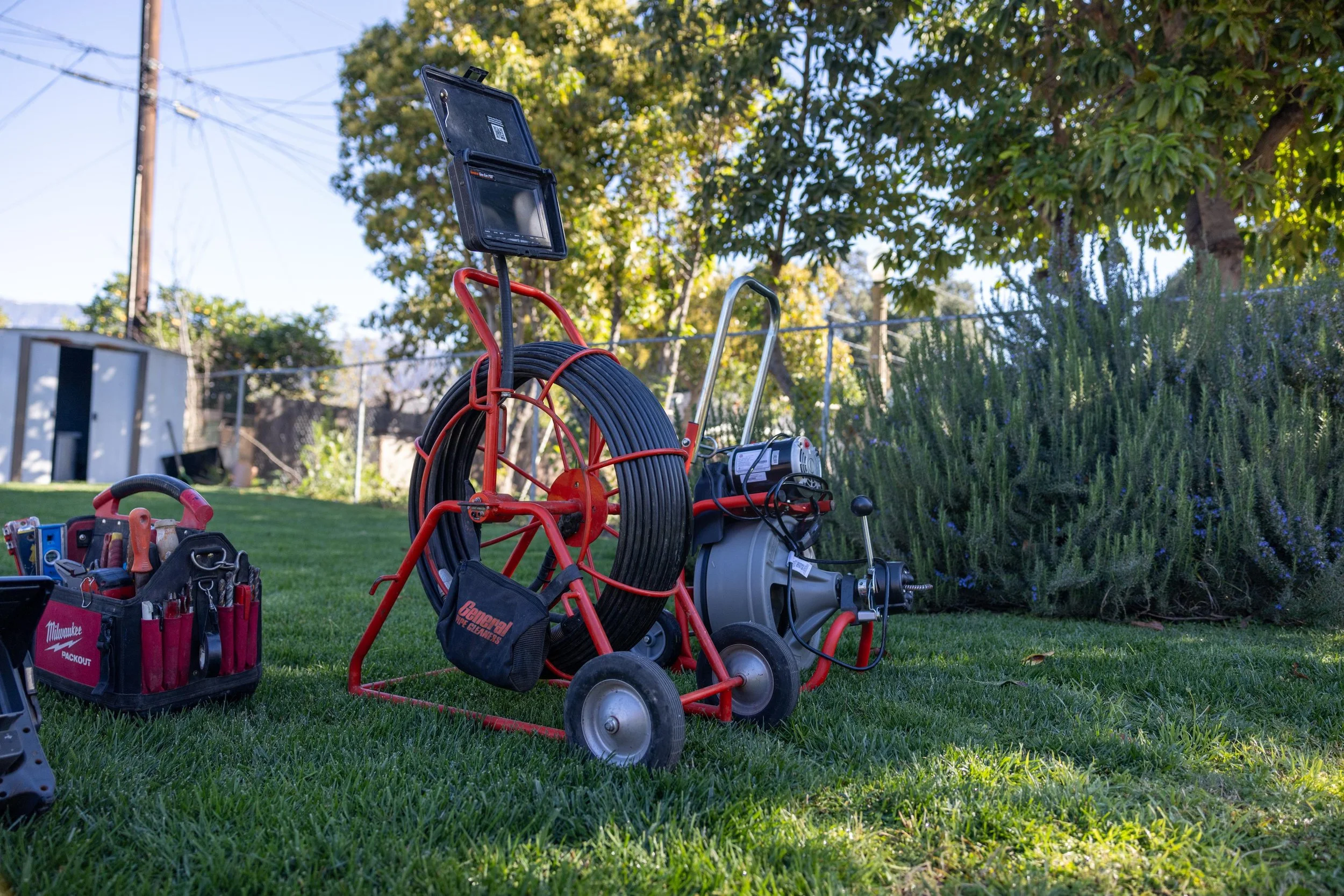
Pre-purchase sewer camera inspection is a regular service in SM's high-value residential market. A $3-million-plus home transaction warrants knowing what's underground before closing. The same camera serves recurring-backup diagnosis and post-repair verification. The team locates problem positions precisely with the sonde transmitter and provides video documentation for records.
Heritage Home Repipe Scope
Galvanized supply lines from SM's 1920s-1930s development era are decades past their service life — most have been retrofitted at least once in the past century, but the underlying age means original sections may still be in walls. The team scopes whether partial repipe (failing branches only, lower disruption to heritage interior finishes) or whole-home repipe is the better economic call for the property. For Spanish Colonial Revival homes with original-fabric tile, plaster, and stucco, partial repipe phased over multiple visits often preserves the architecture while addressing the worst water-pressure issues.
Hydrojetting and Drain Cleaning
Hydrojetting at 1,500 to 4,000 PSI handles severe blockages and recurring root intrusion. San Marino's mature trees mean steady root-intrusion patterns in clay sewer laterals; scheduled jetting maintenance every 1-3 years is often more cost-effective than waiting for the next backup. For heritage properties with substantial landscape investments, preventive jetting protects both the plumbing and the gardens.
Leak Detection and Slab Leak Repair
Slab leaks show up in San Marino's mid-century-built homes where copper supply lines under the slab have hit end-of-life. Warm spots on the floor, sudden jumps in the water bill, sound of water running with everything off — those warrant electronic leak detection rather than waiting for visible damage. For pre-1950 San Marino homes with raised foundations, hidden leaks behind walls are the more common pattern; electronic leak detection narrows down location before any drywall comes off.
Gas Line Services for Custom Kitchens
San Marino custom-home kitchens often run commercial-style ranges, multiple ovens, dedicated wok stations, outdoor BBQ setups, and pool/spa heating that demand gas service sized substantially above the residential code from when the original lines were installed. The team handles gas line resizing from the meter, repair, leak detection, and code-compliant pressure testing. For larger SM homes adding tankless heaters, in-law suites, or kitchen capacity, gas-side scope often outweighs water-side work.
Bathroom Plumbing for Heritage Remodels
Bathroom remodels on San Marino heritage properties include rough-in for relocated tubs, showers, vanities, and toilets, plus bringing older drain venting up to current code. For Spanish Colonial Revival homes with original-fabric tile work, the goal is usually to update functional plumbing while preserving as much of the original architectural character as the homeowner wants to keep.
San Marino Areas We Serve
San Marino is geographically compact (~3.8 sq mi), and the team covers the entire city as a single operational footprint. The areas worth naming.
The Huntington Library / Oxford Road area — northwestern SM around 1151 Oxford Road. Surrounding residential is some of the most preserved 1920s estate housing in the city.
El Molino Viejo / Old Mill area — near the Pasadena border in the San Rafael Hills section of northwestern SM. Heritage character, surrounding residential blocks built to echo the Old Mill's California-Mission aesthetic.
Lacy Park area — central residential community park anchor, surrounded by 1920s-1930s housing stock.
San Marino High School area — central residential, family-occupied homes driven by the top-rated SMUSD.
Crowell Library area — central community anchor (library), surrounding residential streets.
Huntington Drive corridor — the San Marino stretch (distinct from Pasadena's stretch of the same street). Limited commercial scope; mostly border-corridor residential.
South of Huntington Drive — residential blocks heading south toward the Alhambra border, mid-century housing mixed with 1920s heritage.
How a San Marino Job Runs With Us
Honest diagnosis, clear options, and no work starts until the price and scope are agreed in writing. San Marino homeowners — many of whom live in heritage properties they've owned for decades — get extra context on the engineering reasoning behind recommendations rather than marketing language.
Call (626) 247-3401 or request a free estimate online. We schedule visits during business hours (Mon.–Fri. 8 a.m. to 5 p.m., Sat. 9 a.m. to 1 p.m. by appointment). Sunday emergency calls are accepted for genuine emergencies — burst pipe, active sewer backup, gas leak.
For Historic Preservation Commission-designated landmark properties, we flag any exterior-affecting work upfront and coordinate the preservation review timing into the schedule rather than blowing past it.
On site, the technician diagnoses with the right equipment — sewer camera for backup symptoms, electronic leak detection for hidden leaks, pressure testing for gas. For heritage homes, the diagnostic pace is slower; we'd rather understand what's there than guess.
Written estimate before any work begins. Scope, parts, labor, timeline. Transparent pricing — if there's a range in the price, the reason for the range is explained.
Work performed by Jason or his trained team. 100% satisfaction guarantee on completed work. City of San Marino permits coordinated when required.
What San Marino Customers Say
Service Areas Around San Marino
Plumbing Professionals serves San Marino and the surrounding cities and CDPs:
Pasadena — directly north, our HQ city (Huntington Library sits at the SM-Pasadena border)
South Pasadena — northwest, small affluent city with its own Rialto Theatre heritage
Alhambra — directly south
San Gabriel city — southeast (same 1913 incorporation year as SM)
East San Gabriel CDP — pocket between SM and Arcadia
Arcadia — east, also affluent with its own Lucky Baldwin estate heritage
Temple City — further east